In my last post, I quoted Roxana Bacon, the former Chief Counsel of U.S. Citizenship and Immigration Services (USCIS), our nation’s premier agency charged with determining eligibility for immigration benefits, who chided her erstwhile employer for “timidity” in failing to take legitimate administrative steps to reform America’s broken immigration system.  While her point is correct, I am furious at USCIS, not just for timidity on immigration reform but also and especially for yellowed boldness and bureaucratic chutzpah.

 3630661574_29cd6eacf8_s.jpg

Don’t get me wrong, the agency occasionally makes the right call, like its prompt assistance in offering extraordinary relief at times of natural disasters such as earthquakes in Japan and Haiti.  Another correct move is the announcement that USCIS will focus more resources on targeting “fake immigration attorneys.”  In particular, the attack on individuals without law licenses who harm the vulnerable public and abuse trust by failing to understand or misusing the immigration laws is worthy and urgently needed. (Indeed, the Department of Labor should mount the same attack by eliminating from its PERM labor certification regulations the authority of unlicensed “agents” to represent employers and foreign citizens.) 

What enrages me with the USCIS, however, is its toleration, coddling and empowerment of adjudicative officers in its own agency who likewise (in most instances) lack admission to any state bar and are beholden to no canons of legal ethics.  These officers, in my experience and that of many lawyers, regularly abuse the vunerable public by failing to understand and — whether wittingly or unschooledly — misapplying one of the most complex bodies of federal law, the immigration laws. Needless to say, much of what makes life worth living is riding on a proper interpretation and application of these befuddling laws:    

Knowledge of [immigration] statutes, cases and agency regulations are required . . . to evaluate both the nature and the quantum of proof required in each type of case. The legal rights and privileges involved are some of the most basic to the individual: the right to travel, the right to obtain or retain residence in this country, the right to citizenship, and liability to criminal prosecution. [Source: Unauthorized Practice Of Law In Immigration Matters]

I am not as incensed by garden-variety sloth and ineptitude, like the ever-proliferating boilerplate Request for Additional Evidence, asking for the sun, the moon and the kitchen sink, released without customization to the facts of the case, but with inadvertent inclusion of the phrase: “[Insert name of petitioner here].”  No, I am enraged that a body within USCIS that purports to be a legal tribunal, the Administrative Appeals Office (AAO), would allow non-lawyers to render legal opinions that “draw . . . borders with pens that split lives like an ax.” 

This license to opine and thereby destroy lives is no less outrageous than the Empire State’s archaic Justice of the Peace system exposed by The New York Times, where roughly three-quarters of the “jurists” were found to have no bar association membersip.  The AAO reportedly employs lawyers and non-lawyers, according to comprehensive and worthy notes by Carlos Holguín of the Center for Human Rights & Constitutional Law (with [his bracketing]):

Although the AAO considers itself a tribunal, not all of its “jurists” are lawyers. [While, as was claimed during the [AAO] Listening Session, non-lawyer decision-makers can issue opinions as solidly as their attorney counterparts, persons not licensed as lawyers are not subject to discipline under the rules governing judges and lawyers.]

The other leading administrative tribunals that research and opine on the immigration laws, render decisions and designate some as binding precedents are the Immigration Judges and the Board of Immigration Appeals whose members must hold an LLB or JD degree and be duly licensed to practice law, as must all Administrative Law Judges according to the Office of Personnel Management.  The USCIS, however, apparently views itself immune from these requirements, since the posted job openings for positions requiring research into the immigration laws and the application of law to facts, such as Service Center Director, Overseas Adjudications Officer and Asylum Officer, do not require bar admission or legal education.  Indeed, USCIS gives legal education a comparatively low value, that of a GS-9, equivalent to one year of federal service.

What prompted this tirade against the USCIS and the AAO? I won’t say. The rules of professional responsibility and my duty of confidence and trust owed to specific clients prevent me from outlining the particulars.  Suffice it to note that I am a jaundiced observer of AAO machinations (if you’re curious, that’s why I’m yellow).  Notwithstanding my canary complexion, and general desensitization to specious reasoning, I just received an AAO decision that — were it placed in Olympic competition — would win multiple gold medals for intellectual dishonesty, disregard of precedent decisions, “refudiation” of agency guidance and overall callousness of heart, while purporting to be sensitive and heartfelt.

My fury arises not only from this mean-spirited and legally ignorant decision (which if written by a lawyer would be an embarrassment to the profession) but from the legal structure which allows it to remain protected and virtually above reproach (save for a blogger’s rant), namely, legislative restraints that have placed on courts a duty of fawning deference to agency rulings of law and discretionary decisions. 

As I seethe, I recall what the public has been told last year: USCIS is conducting a top to bottom review; a remarkable Transformation is imminent; and the agency will issue a proposed regulation to clarify the rules of practice before the AAO and lead to the designation of significantly more binding precedent decisions.  More recently, the Inspector General of Homeland Security has warned of threats from potentially rogue employees within USCIS, and suggested numerous fixes, including a proposal that adjudicators’ approved decisions be reviewed by supervisory officers before formal release.  Whether or not the IG’s proposal is adopted, I urge the Director of USCIS to arrange for internal attorney review of every draft decision, interpreting or applying law, written by any immigration officer not admitted to any established licensing bar.

Until then, I rage with an elevated (yellow) level of anger against the immigration machine and its (Un)Adjustment Bureau where non-lawyer “mystery men [and women] running an exceedingly specialized enterprise” participate in a sad governmental parody of yellow journalism that publishes “little or no legitimate well-researched” rulings.
[Photo Credit]    

Ever since studying Constitutional Law years ago, I’ve never really resolved in my mind the tension between federal supremacy and states rights. Most days, I see the need for national uniformity of law and lean toward federal power.   At other times, I appreciate the benefit of sensitivity to local conditions and the wisdom of allowing the states to serve as 50 laboratories to develop what I hope might be enlightened solutions to daunting problems.

The issue arose again this week in an offhand reply I Tweeted to an anonymous, conservative-leaning polymath, who carries the Twitter name “euandus,” in response to his blog post (with identity still masked) entitled, “Immigration and Federalism in the U.S.: Should States like Arisona (sic) Participate?”   

The federalism/states-rights conundrum surfaced again in the Twitterscape, this time with a thoughtful blog post by “Chakazoid” — a likewise unidentified inhabitant of the virtual world — who wrote, “My Crazy Theory on Immigration.”  Chazkazoid, an apparently precocious college student, wondered aloud why Georgia, in trying to outdo Arizona, proposed a Jim Crow anti-immigrant bill that suddenly became “more lenient” (his supposition: “to protect the agriculture industry”).

I’ve viewed these state excrescences as affronts to federalism, and suggested as much to euandus, by noting that having “50 state versions of immigration laws would be as dysfunctional as were the Articles of Confederation.” My hope has been that the U.S. Supreme Court in the already-argued case of U.S. Chamber of Commerce v. Candaleria, will scuttle Arizona’s efforts to neuter the federal preemption doctrine by attempting to regulate immigration.  After reading the transcript of oral argument in Candaleria, however, I’ve become less hopeful that preemption will prevail.

The prospect that the states might be given free reign to legislate in the immigration domain chills my spine like an icicle.  (It would be a mess for all of us if we were required to carry internal passports and get visas to go from state to state. And, yikes, how would I ever learn 50 state immigration codes?) 

Then I read an op-ed by Jason L. Riley in the March 5 Wall Street Journal, “Utah Seeks a Better Way on Illegal Immigration,” that gave me cause for modest hope.  Utah state Senator Curtis Bramble, a Republican from Provo, has sponsored a bill with a good chance for passage that would do what has long stymied the federal Congress.  Sen. Bramble’s bill would permit undocumented immigrants in the state who’ve passed a criminal background check to pay a fine of up to $2,500 and apply to the Utah Department of Workforce Services for a temporary work permit. The bill, assigned number 288 (as amended), is premised on the Utah Compact.  The Compact rests on five principles:

FEDERAL SOLUTIONS Immigration is a federal policy issue between the U.S. government and other countries—not Utah and other countries. We urge Utah’s congressional delegation, and others, to lead efforts to strengthen federal laws and protect our national borders. We urge state leaders to adopt reasonable policies addressing immigrants in Utah.

LAW ENFORCEMENT We respect the rule of law and support law enforcement’s professional judgment and discretion. Local law enforcement resources should focus on criminal activities, not civil violations of federal code.

FAMILIES Strong families are the foundation of successful communities. We oppose policies that unnecessarily separate families. We champion policies that support families and improve the health, education and well-being of all Utah children.

ECONOMY Utah is best served by a free-market philosophy that maximizes individual freedom and opportunity. We acknowledge the economic role immigrants play as workers and taxpayers. Utah’s immigration policies must reaffirm our global reputation as a welcoming and business-friendly state.

A FREE SOCIETY Immigrants are integrated into communities across Utah. We must adopt a humane approach to this reality, reflecting our unique culture, history and spirit of inclusion. The way we treat immigrants will say more about us as a free society and less about our immigrant neighbors. Utah should always be a place that welcomes people of goodwill.

A leading proponent of Utah Bill 288, Natalie Gochnour, Chief Economist for the Salt Lake Chamber of Commerce, explained her support to Riley in his Wall Street Journal op-ed: 

Utah has a growing economy that’s ready and able to put people to work. Our business leaders are saying, ‘Let’s not diminish our labor supply.  Let’s not reduce our customer base.  Let’s not raise business costs. Let’s not detract from outside investment, convention business [and] tourism.’

Of course, to be effectual, Utah’s guest worker program would likely need a federal waiver (unless Candaleria is decided in Arizona’s favor). Existing precedent for the delegation of authority over immigration benefits already exists with the federal government’s Conrad 30 program, which allows each state to sponsor physicians for waiver of the two-year, home-country residence requirement of the J-1 Exchange Visitor visa category.  (Utah, by the way, is not alone in proposing that states mobilize to gain the ability to issue internal work visas, as Ezra Klein of The Washington Post has argued persuasively.)

While Utah moves forward on a humane and pragmatic state-level strategy, Chakazoid, ever the optimist, still harbors hope for a federal solution:

Whatever the underlying issue for the slow progress on immigration, I have faith that we will come to our senses. We should be more welcoming to immigrants from every country and find a way to once and for all deal with the 12 million illegal immigrants already here. The solution should be pragmatic, involve a comprehensive reform, and benefit our economy, along with a bipartisan effort. We may sit here and play the blame game, as congress has been doing for the past decade, but it is this very game in which America is losing.

For my part, I see less reason for optimism.  I join in the “stinging rebuke” leveled in the March issue of Arizona Attorney by my former partner and recently-retired Chief Counsel of USCIS, Roxana Bacon, who candidly decried the “legislative irresponsibility and the lack of executive leadership” of official Washington in the passage below (emphasis mine):

Forget that Comprehensive Immigration Reform (CIR) died a premature death last spring. Charles Schumer and Lindsay Graham, two heavy hitters, refused even to introduce the modest CIR legislation, drafted largely by DHS, because they were unable to get a single other Senator to sign on. Leadership, anyone?

The White House was mostly MIA, with attention so glued to other matters that even a rousing march to the Capitol by Dream Act kids and thousands of advocates merited no real action.  Indifference, anyone?

. . . [USCIS] stayed underground, armed with bureaucratic plans and a PR machine rather than visionary policy statements or practical field directives that would move us forward. Timidity, anyone?

However, not everyone stood down.  CBP and ICE went into overdrive to detain more people, remove more people, and exercise less discretion than at any time in our nation’s modern history.  . . . When advocacy groups questioned this 180-degree pivot from the campaign, they were told that no reform would be politically feasible until the anti-immigrant politicians were convinced that this Administration was tough on immigration.  The groups who hijacked the immigration conversation will never be appeased.  Not a good strategy. . . . [Reform] by increased enforcement was hardly the campaign promise. Duplicity, anyone?

Roxie Bacon likewise looks to the states “as the most logical and invested laboratories to sort through the complications inherent in deciding what a vital and secure immigration law should look like,” not to mention the courts, “emboldened advocates, who stand up to meanness and indifference in the face of human suffering and need, and [to] inventive lawyers representing them.”

It’s not too late for the Federales in DC to renounce their “collective ostriching,” as Roxie describes their posturing.  Perhaps now, with the economy in rebound, unemployment finally less than 9%, and the states at the ramparts poised to usurp the federal role in immigration policy, our pusillanimous “leaders” in Washington will at last take pragmatic and humane steps to pass comprehensive reform, or at least grant Utah and other states the right to fix our dysfunctional system. 

* * *

POSTSCRIPT In a hectic day and night of amendments and maneuvers, the Utah legislature passed two immigration-related measures that together comprise comprehensive immigration reform at the state level.  One of these, HB 116, creates a Utah guest worker immigration program. The other, HB 497, is said to focus on serious crimes.  The federalism/states-rights tension continues. 

The weather outside is frightful. Large chunks of hail are beating the earth in the form of “Notices of Inspection” (NOIs), delivered by U.S. Immigration and Customs Enforcement (ICE).  These NOIsome ICE chunks are hitting the doorsteps of more and more U.S. employers (1,000 have just landed). Even in unlikely San Francisco I understand that at least two large employers are shivering as they prepare to respond with loads of Forms I-9 (Employment Eligibility Verifications) on past and present employees and other requested business records.

In the past, large employers adopted a Goldilocks approach when seeking shelter from the storm.  Businesses of heft and breadth realized that the risk of employer sanctions had historically remained small since the former INS mostly audited small or mid-size employers, and ICE, the successor agency, preferred high-visibility raids over the more tedious inspection of immigration paperwork.  Thus, large employers pursued a strategy of “just right”:  Neither so much vigilance over I-9 compliance practices that might risk an antidiscrimination charge, nor so little diligence that might trigger a raid. 

All that has changed with the Obama Administration’s focus on civil enforcement through paperwork inspections, followed predictably by fines, orders to terminate unauthorized workers, and criminal prosecution of businesses and individuals the Justice Department considers flagrant immigration lawbreakers.  

Given the change in enforcement strategy, large employers (and those of lesser size) can no longer rely on a Goldilocks approach, as Ted Chiappari and I explain in “Goldilocks’ Lessons for Dealing with Bearish Immigration Police,” published on February 23 in The New York Law Journal.  Our “Goldilocks” article offers detailed precautions employers of all size should consider immediately to mitigate potential ICE-storm damage: 

1. Review  Immigration Compliance. Engage an experienced immigration law firm (other than the one used to prepare and submit the employer’s immigration petitions and applications) to conduct a full-fledged 100% audit of all I-9s for current and former employees (including those who joined as a result of corporate acquisitions) and evaluate all other immigration-compliance obligations. 

2. Decide How the Auditor Should Present the Report.  Consider the pros and cons of an oral versus a written audit report.  An oral report advises management without creating what may be an unhelpful paper trail, if not all of counsel’s curative recommendations are followed; whereas a written report, submitted to ICE if and when the company is audited, demonstrates good-faith compliance. 

3. Expect Bad News and Deal with It. Even the most persnickety employers who try their darndest to winnow out unauthorized workers are likely to discover that some segment of the workforce has no right to work and must be terminated while the I-9s of others must still be corrected.  Careless employers will fare worse.  Consider conducting the audit in phases, tranches or by worksites so that, if workers must be terminated, replacements can be hired or engaged through a temp agency, and then trained, all of which can occur in less disruptive ways than if a sizable roster of unauthorized employees were fired at once.  Also, be sensitive to the possibility that discrimination and wrongful-discharge claims or union grievances may be lodged, and behave in ways to minimize harm from those forms of employee blowback.

4. Develop and Enforce an Immigration Compliance Policy. Announce to employees and the world your company’s immigration policy, namely, that you hire only authorized workers, do not violate antidiscrimination rules, and appropriately discipline those who fail to comply.  Consider other best practices to foster that central policy of maintaining an authorized-only, discrimination-free workplace, maybe even some best practices from IMAGE.

5. Place Controls on Employment-Based Immigration Sponsorship. Make sure the decision to petition for work-visa or green-card benefits on behalf of each foreign worker is justified in writing under objectively fair criteria.  Protect against cronyism.  Centralize due-diligence and signature authority concerning the factual representations made in all immigration submissions.  Require systematic record-keeping and compliance with other obligations such as posting and good-faith recruiting procedures.

6. Add Immigration Protections to Vendor Contracts and Manage Vendor Conduct.  Avoid the risk of deemed co-employment and of being tainted by the possible immigration violations of vendors and consultants.  Make sure immigration-related attestations made for the benefit of vendor employees are vetted for accuracy and that vendors are contractually required to adopt and enforce their own immigration compliance policies, with contractual penalties imposed for noncompliance.

7. Strengthen Global Mobility Management.  It’s not just about complying with U.S. immigration laws.  Foreign countries’ immigration statutes can be just as nasty when the rules are violated.  Other laws outside of the immigration domain, such as the Foreign Corrupt Practices Act, the new United Kingdom anti-bribery legislation, taxation, employee benefits, employment laws, and conflicts of law, as well as European Union and national regulations relating to privacy and electronic-data transmission, must also be honored.  Bad immigration press and sanctions in one country may spark a storm of brand damage around the world.

In short, Goldilocks’ behavior (lying dormant in a domain where cold-hearted ursine characters are likely to frequent) is no longer safe for prudent employers.  Beware the ICE Bears.

On February 18 and 19, the University of California (Irvine) hosted a symposium where many of U.S. immigration’s Rock-Star professors came together to try and solve “Persistent Puzzles in Immigration Law.”  The topics covered a wide expanse. A subject discussed that particularly interested me is Congress’s often inexplicable delegation of regulatory authority among a surfeit of federal agencies that administer and enforce the immigration laws, each with its area of real (or presumed) expertise and overlapping responsibilities. 

One speaker mentioned her concern about the possible mis-use of E-Verify by some employers to screen current or would-be workers for employment eligibility, even though that kind of screening violates the terms of use under the memorandum of understanding with Homeland Security (DHS).  She proposed that perhaps Congress should authorize the Department of Labor (DOL) to investigate and punish this type of violation.  During the Q & A, I suggested that, even if the problem is as widespread as the speaker feared, the Department of Justice (DOJ) should do the policing, because, based on my experience, DOL must first improve its abysmal record of administering the immigration laws before Congress grants it any more power.

Regular readers of this blog would be forgiven for assuming, given my recent rants on labor certification (here and here), that the DOL’s PERM program had come to my mind.  No, actually I was thinking of the H-1B program and a January 2011 Government Accountability Office report (GAO-11-26). Although the report contains a wealth of data, and is written from a glass-half-empty perspective, it actually shows that access to cheap foreign labor — the usual slam against the category — is not the real motivation for its use.  Rather, as the National Foundation for American Policy notes in its analysis of the GAO data, “hiring the best candidate for the job, whether U.S.-born or foreign-born, is the primary consideration for employers” who sponsor H-1B workers.

I will offer many critiques of the economy-harming H-1B program in future blog postings, and assail the GAO’s flawed analysis and implied bias reflected in the title of its report (“H-1B VISA PROGRAM – Reforms Are Needed to Minimize the Risks and Costs of Current Program”).  For now, in the au courant Washington spirit of reducing government expenditures and eliminating unnecessary regulations that burden business, I propose that Congress take the DOL out of the H-1B application process altogether, and that USCIS serve solely to approve or deny H-1B visa petitions and grants of nonimmigrant status.  

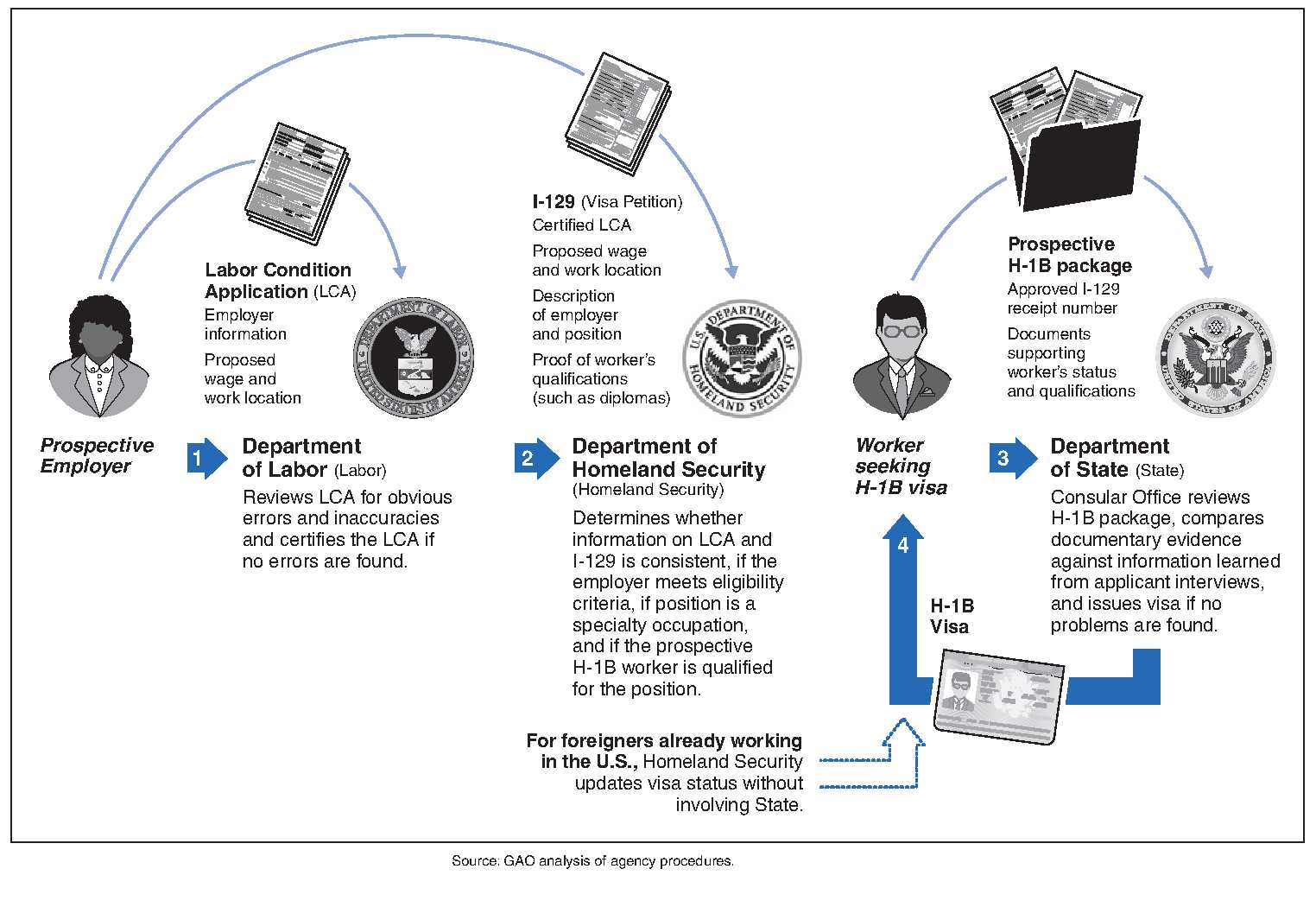
To gain a visual understanding of my point, consider this GAO chart depicting the current H-1B process:

How to get an H-1B Visa or H-1B Status.jpg

As the chart shows, the only role for the DOL at the outset of the H-1B process is to perform a ministerial task, i.e., to review an employer attestation form (known as the Labor Condition Application or LCA) to confirm that it is not “incomplete or obviously inaccurate.”  The GAO agrees with me that Congress should consider eliminating this step, and instead requiring U.S. Citizenship and Immigration Services (USCIS) to receive and certify the LCA when adjudicating the H-1B visa petition:

To reduce duplication and fragmentation in the administration and oversight of the H-1B application process, consistent with past GAO matters for congressional consideration, [Congress should] consider eliminating the requirement that employers first submit a Labor Condition Application (LCA) to the Department of Labor for certification, and require instead that employers submit this application along with the I-129 application to the Department of Homeland Security’s U.S. Citizenship and Immigration Services for review.

Eliminating the LCA review by DOL would shave seven days off the time it takes before USCIS can adjudicate an H-1B petition, since this is the time Congress provided the DOL to “certify” the LCA. This savings of time is especially important each year in March when every day counts as employers scramble to file their H-1B petitions by April Fools Day in order to fall within the woefully small H-1B annual quota. 

USCIS opposes the GAO’s suggestion, however, offering the following rationale to the GAO:

Homeland Security officials believed that Labor would be better suited to review the LCA because Labor has specialized knowledge about the computation of prevailing wages.

USCIS’s justification for shirking a task that would result in an obvious time- and cost-savings doesn’t stand up to close scrutiny.  Most employers use the DOL’s online O*Net database and Standard Occupational Classifications to obtain the prevailing wage, and USCIS could easily cross-check those sources (as it now does with its VIBE system) to make sure the correct wage figure is used.  Even in the comparatively rare situations where an employer submits an alternate wage source, USCIS could easily adopt and apply DOL’s regulations on the requirements for use of a union contract, an “independent authoritative source” survey, or “[an]other legitimate source” of prevailing wage data, or consult with the DOL.

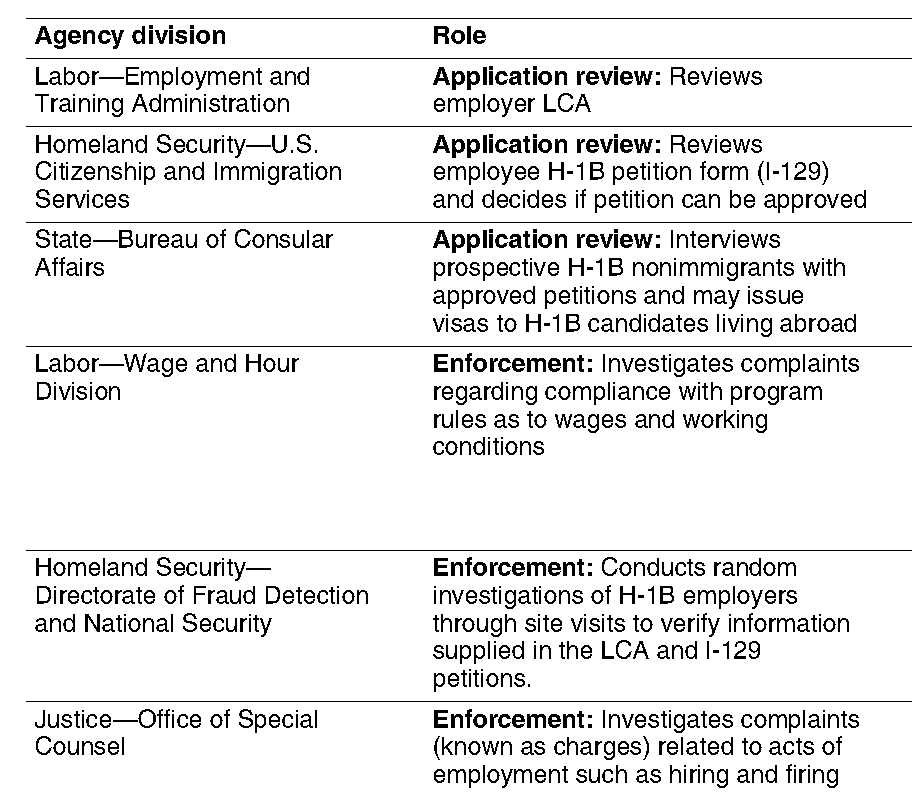
Avoiding front-end delay is just a first step in process improvement.  The more urgent challenge is how best to consolidate enforcement of the H-1 program in one agency.  The current enforcement hodgepodge is reflected in this GAO chart:   

 Agency Roles.jpg

There is no reason that H-1B employers, by regulation, must be prepared to face a triad of investigations by three federal agencies housed in three different departments.  H-1B enforcement responsibility should be consolidated into one agency, and the rules governing the procedures, scope and duration of an investigation, along with employer due process protections (such as the Good Faith Compliance defense added by the H-1B Visa Reform Act of 2004) should be promulgated under the customary requirements of public notice and opportunity for comment under the Administrative Procedures Act

As I suggested to the immigration law professors, my recommendation would be to place all immigration policing authority with the Office of Special Counsel for Unfair Immigration-Related Employment Practices (OSC) in the Justice Department under an expanded grant of authority.  The money we’d save and the burdens lifted by permitting USCIS to serve as sole H-1B adjudicator and pinning on OSC the lone sheriff’s star would be substantial. An added benefit would be that a neutral actor, the Justice Department, would have no dog in the fight, unlike the DOL whose mission is “foster[ing] and promot[ing] the welfare of the job seekers, wage earners, and retirees of the United States,” rather than according fair process to employers. 

So, Congress, in keeping with the zeitgeist, can you spell?:

I-M-M-I-G-R-A-T-I-O-N

D-E-F-I-C-I-T

R-E-D-U-C-T-I-O-N

I must be becoming more wizened than wise at this stage of my legal career to judge a bill by its title.  But the label of the proposal to be introduced this week by Sen. Orrin Hatch (R. Utah) lulled me into a state of naïve credulity. It seemed like a refreshing change from the usual stew of comprehensive immigration reform proposals in which a path to legal status for the undocumented tends to grab most of the headlines. 

The first part of the title to Hatch’s bill seemed as if, finally, reforms of the legal immigration system will be front and center (even if the last part of the title is all too familiar): 

Strengthening Our Commitment to Legal Immigration and America’s Security Act.” 

I should have known that, at a time when Sen. Hatch faces a primary challenge on his right flank by the Tea Party, he would not again show the colors of the old Orren.  That Sen. Hatch, as OnTheIssues.Org reminds us:

  • Voted YES on allowing more foreign workers into the US for farm work. (Jul 1998)
  • Voted YES on visas for skilled workers. (May 1998)

No, latter-day Orren has done a bait-and-switch with the title of the bill, because, as he describes its contents, nothing in it would improve the legal immigration system or help those who play by the rules.  His bill would instead:

  • Take away from the President the blanket authority to grant parole and deferred action, except on a case-by-case basis, 
  • End the Diversity Lottery,
  • Require “law enforcement agencies that are selected and enrolled in the 287(g) and Secure Communities programs to fully comply with the requirements of such programs or risk losing federal reimbursement for incarceration expenses,”
  • Provide “consular officers the necessary legal authority to deny members of known gangs from coming into our country,”
  • Require the Homeland Security Secretary to create a mandatory exit procedure for foreign visitors to the United States,
  • Require the Secretary of HHS to track and annually report the amount of welfare benefits diverted to illegal immigrants,
  • Ensure that tax dollars are being used to cover only American children in federal insurance programs,
  • Increase criminal penalties for identity theft, eliminate defenses and require the IRS to report to the apparent identity-theft victim (or his/her parents) if an employer has not corrected a Social Security No-Match discrepancy involving the victim’s SSN in 60 days after receiving notce that a no-match has been spotted,
  • Keep our national parks and federal lands safe and free from drug traffickers and marijuana cultivation.

Some of these measures may well be worthy.  For example, I have long considered the 50,000 green cards squandered annually through the Diversity Lottery program a national humiliation.  The DV program seems mostly a Congressional confession that pure luck is better at allocating scarce visa numbers than any form of thoughtful merit-based system our legislators could conceive — particularly given that for the last 20+ years the law has allowed only 140,000 employer-sponsored green cards per year.  I also think it makes sense to notify victims of possible identity theft about the improper use of their SSNs. 

The rest of the proposals simply seem beside the point with unemployment staying put at 9%.  Indeed, the enhanced consular authority Sen. Hatch would provide already exists to exclude persons if consular officers have “reason to believe” they are gang members or may engage in law-breaking activity after entering the United States.  And the limit on Presidentially exercised blanket parole authority seems a particularly unwise tying of the Executive’s hands, since that authority has been used properly by Presidents for many decades (recall the mass paroling of refugees by Presidents Truman and Eisenhower).

Aside from wistful nostalgia for the Orrin of old, what comes to my mind when considering his SOCLIASA bill are questions: 

  • Why not propose the recapture of the 600,000 unused green cards that our bureaucrats failed to issue over the last several years, so that Chinese and Indian scientists and engineers won’t return home rather than be forced to wait up to 20 years for U.S. permanent residency?
  • Why not vote to expand the annual 65,000 H-1B visa quota that already ran out with eight months left in the fiscal year (still the same number as when first established in 1990!)?
  • Why not add farmworker visas to help struggling farmers whose produce rots because legal workers can’t be found?
  • Why not pass the Start-Up Visa Act and the Founders Visa Act and eliminate immigration bars to foreign entrpreneurs who will create jobs for Americans?
  • Why not give a boost to the military and academia by allowing innocent DREAMers to get on a path toward legal status?
  • Sen. Hatch, why not stand up for your former principles on legal immigration rather than opt solely and clearly for personal job security? 

Indeed, Sen. Hatch, where are the JOBS that a well-drafted legal immigration bill would create? 

Since January 25, the events in Cairo’s Tahrir (Liberation) Square have transfixed the world.  Following on the heels of the Tunisian people’s overthrow of their despot, the Egyptian uprising reveals a fundamental law of physics: In a closed system, energy can be neither created nor destroyed. 

So too in politics.  Universal political energy — the pent-up longing for freedom and self-determination — is now leveraged and magnified in new and unpredictable ways by Twitter and Facebook. Inexorably, that energy, as the Egyptian protestors have shown us, will ultimately be released. 

Hosni Mubarak’s 30-year authoritarian, pressure-cooker reign, supported throughout by the unmonitored and unaccountable Egyptian police, is coming to an end. And once again, as many times before, the American government and political establishment have been caught flat-footed, on the wrong side of history, knocked over by popular energy, while supporting a fallen dictator.

 A similar dynamic is playing out inside America.  The tightening of the border by “deploying historic levels of manpower, resources and technology and increasing collaboration with federal, state, local and tribal, and Mexican partners” has achieved unprecedented levels of impregnability — according to Homeland Security Secretary Janet Napolitano in remarks at the University of Texas in El Paso last week.  America is rapidly becoming a closed system. 

At the same time, the energy-pressure readings — of Latinos, Asians and other immigrant groups who rightly perceive themselves as targets of xenophobia — are escalating.  As reported by the nonpartisan Migration Policy Institute and the Government Accountability Office, the immigration enforcers, in league with state, regional and city police agencies operating under the Congressionally authorized 287(g) program, are largely unmonitored and unaccountable.  The 287(g) program, touted as a means of apprehending and removing dangerous foreign felons, has instead gone “rogue” and mostly netted petty immigration violators and small-scale misdemeanants, while arousing ire and fear in local immigrant communities

As the energy of righteous anger builds, not only traditional Democrats but even conservative Latinos chide President Obama for abandoning his campaign promises, and failing to try hard, let alone deliver, on immigration reform. The Republicans (notwithstanding Norm Coleman’s recent rebuke of Tom Tancredo) are even more adrift on immigration, mounting a campaign against “anchor babies” and trying to override the 14th amendment’s guarantee of birthright citizenship.

Meantime, despite a virulent economic recession and a record number of deportations, the unauthorized immigrant population (11.2 million in 2010) remains virtually unchanged from the year before, according to the Pew Hispanic Center

All of the essential requirements for an energized reaction are present. DREAMers have nowhere to go but to the street and to their smartphones.  Spanish- and other foreign-language media will report growing resentment, anger and the desire for justice among their U.S. citizen and immigrant readers  — reporting largely unnoticed in the Anglo mediascape.  U.S. politicians of every stripe, like Hosni Mubarak, will be caught unawares when the energy is released. 

Sir Arthur Conan Doyle was correct:  “The world is full of obvious things which nobody by any chance ever observes.”  To politicos of the left and right, the only proper response is, “Duh!” 

Over more than the last 30 years, I’ve advised countless foreign businesses and investors seeking to establish operations in the United States. Many thrived, but some, regrettably, failed to survive. Often, the founders’ inattentiveness to the requirements of U.S. immigration law has been a primary cause of rough beginnings or failures to launch. This blog post will offer best immigration practices and identify traps to avoid when a foreign firm or individual plans to start a business in America.

1.  Respect the Law – It’s Not a Game. The U.S. is no doubt the world leader when it comes to the complexity of immigration laws. Too often, foreign owners and corporate executives assume that just getting past the consular officer and the border inspector are the only hurdles in the path of pursuing their U.S. business objectives. Many entrepreneurs and company founders have yielded to the temptation of claiming to be a visitor seeking entry for business reasons when in fact their purpose is to start an enterprise and begin working in the U.S. These “stealth visitors” also tend to jump the gun by issuing a press release announcing their appointment to head the U.S. subsidiary before they even have a proper work visa in hand. Cutting corners on immigration compliance is no way to launch a U.S. business but an excellent way to face stiff fines and penalties, be deported or end up in jail. The Obama Administration, with enthusiastic goading by Congress, has dramatically ramped up immigration enforcement at all levels. Lesson 1: Understand that playing by the immigration rules is the only prudent way to start and operate a new business in the U.S.

2.  Develop a Viable Short- and Long-Term Immigration Strategy from the Outset. At the start of every new business, passions and enthusiasm are high. Foreign executives and entrepreneurs often want to obtain the quickest and most easily attained work visa possible. They shop for an immigration lawyer with a low fee who will provide the minimum service need to obtain that visa. Little thought is given to the statements made to the government in the process. Descriptions of the applicant’s prior career often are sketchy. Regrettably, in too many cases, long term strategies and initial statements presented to the government in supporting documents provided in order to get the “easy/quick” first visa may be given short shrift. These types of short-sighted thinking often will narrow future options available to obtain a long term visa or a green card (permanent residence). Lesson 2: Take the time to find an experienced immigration lawyer who will outline all options over time and guide the enterprise strategically for the long haul.

3.  Consider Tax and Employment Law Consequences. No worthwhile immigration strategy is devised in isolation. Other U.S. laws, especially those relating to taxation and employment, must be considered and harmonized with the long-term immigration plan. After considering all applicable laws, a wealthy foreign citizen may decide that obtaining a green card, and thereby becoming subject to U.S. taxation on worldwide income, is not quite so desirable as first perceived. An E-2 investor visa, allowing easy entry and exit as well as a long-term, perpetually renewable U.S. visa and the right to work (including work permission for the spouse) may be just as functional as a green card and still offer the possibility of less costly non-resident tax status in the U.S. Similarly, employment laws, especially in heavily regulated and litigious states such as California, may warrant the use of professional employer organizations (“PEOs”), temporary employment agencies or vendors rather than direct hiring – strategies that may affect the immigration plan. Lesson 3: Choose a solid, inter-disciplinary team of tax advisors and immigration and employment lawyers, preferably – for the sake of efficiency and convenience – in a single firm.

4.  Prepare a Solid Business Plan. Increasingly, U.S. consular officers and immigration agencies are demanding a sophisticated set of supporting documents to assure the government that the proposed business will be viable and likely to result in the hiring of U.S. workers and/or the generation of healthy profits. U.S. immigration officials want to be confident that every work or investor visa issued is in full compliance with law. Officials are alert to a variety of frauds perpetrated by visa applicants who may merely wish to frolic in the U.S. or engage in subversive or criminal activities rather than work. The centerpiece to any employment-based visa application and work-visa petition is a detailed business plan. Here is what the immigration authorities want to see in a “credible” business plan:

  • A description of the U.S. business, as well as its products or services, and the firm’s business objectives, strategies and goals.
  • A market analysis identifying the target market, prospective customer demographics, and the relative strengths and weaknesses of competing businesses.
  • A side-by-side comparison of competitors’ products or services and pricing.
  • A listing of required permits and licenses obtained.
  • A process map depicting in words or images the enterprise’s manufacturing, production or service-delivery processes, required materials, and suppliers.
  • The particulars of any executed contracts for supplies, vendor services and distribution channels. The firm’s intended business-development, marketing and sales strategies, including pricing, advertising, customer service and quality assurance.
  • A description of the business’s organizational and ownership structure and the relevant education and experience of its board of directors and key officers and management.
  • An explanation of anticipated staffing levels, a timetable for hiring, and job descriptions for all significant positions.
  • Financial projections outlining anticipated sales, costs, income projections and underlying economic assumptions.
  • A description of the source of funds used for capital investment, together with proof that the funds were lawfully obtained, deposited with the U.S. business and properly applied for legitimate start-up purposes (e.g., acquisition of premises, equipment, insurance, staff, professional services, etc.)

An immigration-related business plan is not necessarily drafted in the same way as a plan intended for submission to angel investors, hedge funds, venture capital firms or financial institutions. The plan is not “pitching” for financing or investment funding; rather, an immigration-related business plan seeks to persuade the government official reading it that the visa applicant and petitioning entity are serious and bona fide. Lesson 4: Make sure to submit a credible, fully-documented business plan.

5.  Gather Foreign-Source Documents and Information Ahead of Time. At the outset of every work-visa application, immigration counsel should provide a detailed list requesting all documents and information needed. The business entities and individuals receiving the list should take pains, before departing for the U.S., to obtain all items and arrange for full word-for-word translations. (The translations need not be officially certified by a government or formal translation bureau, but may be supported by the translator’s certificate attesting that the translator is fluent in the particular foreign language and English and that the translation is an accurate word-for-word rendering from the foreign to the English language.) Lesson 5: Think ahead and gather all required papers and data when readily accessible in the home country.

6.  Be Prepared for the U.S. Visa Interview and Border Inspection. The first step in preparation is making sure that all information entered into the very difficult online nonimmigrant visa application form, the DS-160, is complete and accurate, and that a digital copy is preserved before uploading (electronically submitting) the form to the consular post or embassy. The visa applicant should review with immigration counsel the likely questions to be posed by the consular official at the visa interview or border inspector at the port of entry as well as the applicant’s proposed answers. The applicant should be rested, well dressed and groomed, in business attire, with a minimum of jewelry, makeup or cologne. Any papers carried to the interview or border inspection should be well organized and easily accessed for presentation to the officer. Particulars of the proposed business and job duties, salary, investment amount, etc., should be accurately described, if questions are posed. Applicants should maintain a confident and relaxed attitude but remember at all times that he or she is speaking to a government official with police powers. All statements made must be truthful and complete. Information not asked should not be volunteered. Lesson 6: Treat the consular interview and border interrogation as oral examinations for which preparation is essential and the passing grade is the grant of the requested visa and work-authorized status in the U.S.

7.  Pay Heed to Expiration Dates. At the U.S. port of entry, the inspecting officer will confer on firm deputees allowed admission to the U.S. a nonimmigrant work-visa “status” on an entry card known as a Form I-94 (arrival/departure record). The I-94 “departure” portion of the card will note the visa category and the period of authorized status, either a date certain or for some visa categories, a notation (“D/S”), meaning the entrant may remain in the U.S. for the “duration of [lawfully maintained] status.” Make sure at the airport or land border that the proper period of authorized admission for the particular visa category is granted and that an improperly shorter period is not noted. Request a correction at that point. One should never allow a passport, visa stamp or I-94 form to expire without first having obtained a renewal or extension. Otherwise, the individual may face serious, adverse consequences such as removal (deportation), detention, and a bar to reentry for up to ten years. Lesson 7: Obtain the right length of status authorization at the port of entry and develop a calendaring/tickler system to renew or extend status long before it expires.

8.  Maintain Required Immigration Paperwork and Be Ready for a Government Audit. Employers are required to complete and maintain a variety of immigration paperwork and to present it upon request to the government, and if employing H-1B specialty occupation workers, to any member of the public who asks to see the documentation. The papers (or electronic records) required to be maintained will include the Form I-9 (Employment Eligibility Verification) confirming that each and every U.S. and foreign worker hired has confirmed eligibility to work under an authorized status and has presented documents of identity and work permission for inspection to the employer. The employer in turn must certify on Form I-9 that the documents chosen for presentation by the employee appear genuine and relate to the individual. In the case of an H-1B employer, the business must also maintain a public access folder and relevant payroll and tax records. Lesson 8: Be ready for an immigration-related government audit by preparing and retaining the required business records, and periodically engaging a competent immigration lawyer to audit the firm’s immigration compliance practices.

9.  Achieve Your Vision of the American Dream but Stay Vigilant about Immigration Compliance. Every new business has big dreams. America encourages entrepreneurial dreamers to pursue their goals within the bounds of the law. Initial business plans, however, may change over time. Companies reorganize, merge, are spun off, sold or dissolved. Job duties may “morph” into new assignments and materially different responsibilities. Foreign employees of the initially sponsoring U.S. firm may desire or need to be transferred to the payroll of an affiliated or wholly unrelated business. Foreign owners, investors and officials of new U.S.-based businesses should realize that employment-based work visas are tethered to the original visa petitioner or sponsor and that material changes in employing entity, job duties, job location and other eligibility criteria may require prior notice and approval of the federal government before the chance is allowed to occur. Lesson 9: Stay in touch with your immigration lawyer and let the lawyer know in advance when changes to the terms and conditions of the initial visa petition and application are likely to arise. Your lawyer can then guide you on required immigration-compliance action items.

* * *

With the U.S. still the largest economy in the world, foreign businesses and individuals still yearn to get a “piece of the pie.” As this post has shown, close attention to U.S. immigration laws will make it more likely that the pie will be tasty and satisfying. Welcome to America!

Practicing employment-related immigration law seems much like serving as consigliere to the biblical David and advising him on Goliath’s points of vulnerability (“[smite] the Philistine in his forehead“). As the bar knows well, in immigration matters the brobdingnagian federal government tends to go after the most lilliputian of American businesses. 

The early case law interpreting the duty of employers to complete Form I-9 (Employment Eligibility Verification) illustrates this proclivity.  The immigration enforcers quickly learned that it is far easier to secure an I-9 victory against a small furniture maker or sausage factory, than a national steakhouse chain. Recent history reinforces this trend, as confirmed in the successful prosecutions of predominantly small employers by Immigration and Customs Enforcement (ICE). 

Emboldened by its parade of victories against mostly tiny employers ($7 million in fines against 2,740 firms in 2010), ICE is now poised to target some of America’s largest companies.  As reported on January 20 by the Wall St. Journal’s Miriam Jordan (“Crackdown on Illegal Workers Grows”) in an interview of ICE Chief, John Morton, the agency has opened an “Employment Compliance Inspection Center.” According to Mr. Morton, the new ECIC would “address a need to conduct audits even of the largest employers with a very large number of employees.”  Just as the WSJ scoop reported, ICE’s new ECIC debuted late this week in Crystal City, VA.   It will start with an initial crew of “15 auditors who will support ICE’s worksite enforcement strategy by helping agency field offices around the country expedite Form I-9 audits of businesses selected for inspection by ICE.”

While announcing the new ECIC last week, ICE also continued to trumpet its IMAGE program, an acronym for the ICE Mutual Agreement between Government and Employers.  The name, IMAGE, is a spot-on coinage because the program has proved to be little more than a public relations tactic garbed as a supposedly valuable “self-policing partnership” with the business community to improve immigration law compliance.  IMAGE should instead stand for ICE Makes you Agree to Get Enrolled, since most “voluntary” participants in the program are businesses that faced serious sanctions unless they agreed to enroll in IMAGE and fulfill its requirements in order to settle an ICE enforcement action.

Large corporations not under ICE investigation, however, have generally declined to join IMAGE because its major prerequisite for admission (allowing ICE to conduct an I-9 audit) is a non-starter. 

Why might a large, law-abiding and civic-minded company decline to be audited?  Because voluntary submission to an ICE audit would likely be a violation of fiduciary duty to the company’s stockholders and could well lead to a securities class action.  A savvy plaintiffs’ class action securities lawyer could easily make a winning case against a publicly-traded company that willingly enrolled in IMAGE by asserting the following readily proven facts in a complaint:

  • Approximately 8 million workers are Illegally employed in the U.S.;
  • Pervasive acts of document fraud, identity theft and false attestations of the legal right to work are the means by which law-abiding employers unknowingly hire unauthorized workers;
  • Fastidious compliance with all I-9 requirements will not prevent a company from unwittingly employing unauthorized workers because the I-9 only requires the employer to verify that the documents of identity and work permission presented by the new hire appear genuine and appear to relate to the individual;
  • Enrollment in E-Verify — an online verification system maintained by the federal government, a system still vulnerable to fraud and misuse, according to the General Accounting Office — will not result in the discovery and termination of unauthorized workers currently employed (except for such workers assigned to work under a narrow class of federal contracts) because E-Verify may not be used to determine whether everyone on the current payroll is authorized to work;
  • Given the foregoing situational realities, Defendant Company, if it had operated as a prudently managed corporation, should have known that a voluntary IMAGE-inspired I-9 audit by ICE would likely result in an order from the agency, effective immediately, without grace period, to terminate a material percentage of current workers whom ICE identifies as unauthorized for employment;
  • The abrupt termination of a significant percentage of current workers at Defendant Company has resulted in a major disruption of this IMAGE-enrolled business;
  • Defendant Company’s voluntary enrollment in IMAGE is the foreseeable and proximate cause of the loss of such current workers and has adversely affected Defendant Company’s revenues, expenses, profits, corporate brand and worker morale, thereby leading to a foreseeably precipitous decline in the price of the Defendant Company’s shares listed on public stock exchanges;
  • WHEREFORE, by virtue of its voluntary enrollment in IMAGE, Defendant Company has breached its fiduciary duty to Plaintiff Shareholders, and accordingly this Court should order Defendant Company to pay Plaintiffs a Gazillion Dollars in damages plus attorneys fees (at 40+% of the damage award).

If IMAGE remains a no-go for large companies, what prevents ECIC’s Crystal City auditors from (1) identifying unauthorized workers at a large company served with an ICE Notice of I-9 Inspection and (2) prompting the agency to order the same type of disruptive firing that IMAGE participation would trigger? Apparently nothing (save for due process of law and the prowess of their immigration lawyers). 

ECIC thus may well succeed where IMAGE has failed, as a Washington Post editorial predicts:

If the current policy [of targeting larger companies] turns up the heat on corporations, so much the better; they may in turn increase pressure on Congress to reform America’s broken immigration system. As it stands, that system ignores the fact that millions of undocumented workers play an integral role in the economy and that the nation needs a realistic mechanism for admitting sufficient numbers of low-skilled employees to fill jobs that Americans don’t want, even with the nation suffering from high unemployment.

Ironically, the cutting of ECIC’s red ribbon came within days of Pres. Obama’s announcement in his WSJ op-ed (“Toward a 21-st Century Regulatory System”) of a new executive diktat designed to “bring order to regulations that have become a patchwork of overlapping rules, the result of tinkering by administrations and legislators of both parties and the influence of special interests in Washington over decades.” 

Surely, the I-9 process — a compliance program plagued by “overlapping rules,” long-term legislative “tinkering” and the “influence” of union and management lobbyists — could stand a fresh look.  Just as the Obama Administration determined that it should not proceed with its Social Security No-Match amendment to the I-9 regulations, the Administration and a bipartisan Congress should take other felicitous steps: 

  1. The Administration should update and reissue the INS 1998 proposed regulation and then at long last promulgate a final rule that would offer definitive guidance to employers by formally interpreting the 1996 statute — the “Sonny Bono Amendment” found at INA § 274A(b)(6)(A), (B), and (C) — that forgives employers acting in good faith who are found to have committed “technical or procedural” I-9 paperwork violations if the mistakes are corrected within 10 days of notice by ICE.
  2. Congress should scrap E-Verify or let it expire on schedule in 2012 and replace it (as well as the I-9 obligation) with a system that relieves employers of the governmental function of serving as the immigration police by developing a tamper-proof photo ID card that workers could swipe at the time of hire and thereby prove to employers their entitlement to work.
  3. Congress and the Administration should establish an “Employment-Based Immigration Truth and Reconciliation Commission” as part of a comprehensive immigration reform which would regularize the status of unauthorized workers and allow for orderly, humane and adequate future flows of workers on lawful visas.

Until these or other workable proposals are enacted, the salutary potential of our immigration laws to unleash the powerful forces of innovation and job creation will remain but an unrealized and wistful opportunity. Meantime, ECIC will presumably ensnare some large employers whose workforces will be decimated or whose immigration lawyers successfully fend off, in true Davidian style, the increasingly gargantuan ICE.

The title of this blog is preposterous, you say. The “Grand Old Party” and “Socialism” — the words are simply inaptly juxtaposed in the same sentence. Strange as it seems, however, when it comes to immigration policy, a reading of the political tea leaves foreshadows a new trend line for the Republicans, one indeed headed down a slippery slope toward socialism’s hallmark, the “bureaucratization of economic life.”

Rep. Lamar Smith (R. Tex.), incoming Chairman of the House Judiciary Committee, recently told Politico that his first two hearings will focus on (1) immigration-related worksite enforcement by the Obama administration, and (2) the expansion of E-Verify, Homeland Security’s still-error-prone system of electronically verifying employment eligibility for all workers in the U.S., citizens included.

For now, E-Verify is arguably voluntary except for certain federal contractors and — depending on how the Supreme Court decides an already argued Arizona case — for businesses in states and municipalities that require it. Smith appears poised to make E-Verify mandatory for all U.S. employers. He also seems eager to become a tougher sheriff than the President, a particularly aggressive immigration law enforcer who (by means of “silent raids“) has assiduously targeted businesses suspected of violating the immigration laws.

According to Rep. Smith:

[Worksite enforcement and E-Verify] are what I call 70 percent issues — 70 percent or more of the American people support those efforts . . . I think they are popular across the board, and I think they will be appreciated by all American workers regardless of their ethnicity or background or anything else.

How will Republicans expand E-Verify and surpass Pres. Obama’s precedent-setting enforcement record yet maintain any hope of keeping one of their key promises in the GOP’s Pledge to America? The Pledge promises that the Republicans “will rein in the red tape factory in Washington, DC by requiring congressional approval of any new federal regulation that may add to our deficit and make it harder to create jobs.”

Ironically, elsewhere in the Pledge, the GOP lays bare the very problems with increased worksite enforcement and E-Verify:

An unchecked executive, a compliant legislature, and an overreaching judiciary have combined to thwart the will of the people and overturn their votes and their values, striking down long-standing laws and institutions and scorning the deepest beliefs of the American people. . . .

We will end the attack on free enterprise by repealing job-killing policies and taking steps to assure current businesses and future entrepreneurs that the government will not stifle their ability to compete in the global marketplace.

A “compliant legislature” of Republicans and Democrats, with the help of an “unchecked executive,” Barack Obama, resurrected and extended E-Verify for three years even though the program was set to expire in 2009. Indeed, Sen. Jeff Sessions (R. AL) argued at the time that three years was not enough.

E-Verify and its paper-based, complementary mandate, the Form I-9 (Employment Eligibility Verification) — a one-sided form requiring four pages of instructions and a 56-page manual to explain — indirectly imposes costly, time-consuming and distracting burdens on employers. These duties are an indirect imposition that the federal government, in an efficient system, ought to bear on its own, namely, the identification of foreign citizens who have no right to work in this country.

A truly Republican approach to the verification of employment eligibility would lift the burden to verify the right to work from the shoulders of employers. Instead, the federal government would itself determine eligibility and confirm each worker’s employment authorization by issuing a tamper-proof work permit that the worker could swipe at the worksite on the date of hire. Employers would thus no longer be required to maintain any I-9 paperwork. Thus, Republicans would keep their Pledge. They would “rein in the red tape factory in Washington” and refrain from “stifl[ing] the ability of U.S. employers to compete in the global marketplace.”

There are other things Republicans can do to reverse their slide into socialism, especially if they want to create jobs for unemployed citizens. The GOP can start by recognizing that carefully crafted laws promoting legal immigration will materially increase the economic security and prosperity of all Americans. The Republicans should also take these baker’s-dozen EBI-promoting steps:

  1. Enact NEVA (which would allow employers to outsource the burden of employment verification to licensed third parties) as an interim measure leading to the abolition of the E-Verify and I-9 programs.
  2. Create a Cabinet-level immigration position with sufficient authority, staff and budget whose sole mission would be to promote “Employment-Based Immigration” (EBI).
  3. Expand or eliminate EBI Quotas. These quotas have not been adjusted since 1990 and have not grown apace with the size of the economy. Republicans should look at recent usage levels and recognize that the market is the best indicator of need for foreign workers and either create an elastic cap or eliminate the quota entirely.
  4. Enact the AgJobs and DREAM Acts. Food security and national defense — twin totems revered by Republicans — go hand in hand with the enactment of these two measures.
  5. Enact the E-2 Nonimmigrant Investor Adjustment, Start-Up Visa and Founder’s Visa bills into law. What is it about the word “entrepreneur” that Republicans don’t understand?
  6. End the hoax that is the Labor Department’s PERM program and instead require the agency to identify jobs for which there are labor shortages. This would “eliminate government waste and red tape,” a time-honored Republican chant.
  7. Enact a documented worker nonimmigrant visa category (with a dependents category reserved to spouses and children) for the eight million undocumented migrant workers in this country. Require the worker to pay a steep user fee in return for permission to work in the job they already hold, and allow them to travel abroad and reenter the U.S., thereby spurring job-creation for the airlines and travel industry. Just as Republicans refused to raise taxes in the middle of a recession, they likewise should not exalt the need to punish violation of a misdemeanor (entry without inspection) over costly and ultimately unattainable enforcement objectives that would substantially add to the deficit. If they must (although I don’t agree), the GOP could include a spoonful of sugar, an express bar to permanent EBI benefits or a path to citizenship through this program (but no bar to permanent residence and citizenship if they qualify in other legally recognized ways).
  8. Enact an EBI Truth and Reconciliation Commission. Everyone knows that the broken immigration system, especially in industries that have historically employed large numbers of low skilled workers, has led to the creation of a “look-the-other-way” and “these-documents-seem-fine-to-me” mode of business in which employers may claim “plausible deniability” or (wittingly or unwittingly) turn lower-level employees into lawbreakers, naïfs or stooges. The GOP should give employers and their managerial staff willing to come forward the chance to admit their knowledge or suspicions of having employed unauthorized workers, pay a hefty fine, and receive “immunity” because the “tribe has spoken.” Sounds extreme? Compare it to the recent IRS announcement that the taxing authorities are considering the renewal of criminal immunity for tax law violators.
  9. Enact an EBI waiver of unlawful presence. Rep. Smith’s baby, born in 1996, the unlawful presence three- and ten-year bar has trapped many an EBI beneficiary or dependent. The waiver should be granted by USCIS upon a showing of either a non-wilful violation or of hardship to the worker or the employer if the waiver were to be refused.
  10. Enact a law that requires video-recording of all EBI visa applicants at consular interviews. Video-recording will provide a record that enhances homeland security while making sure that consular officers are disinclined to browbeat or treat visa applicants unfairly.
  11. Expand the Premium Processing Program for all EBI-related cases. Premium Processing fees for expedited decisions should be expanded to B-1 business-visitor change of status requests and all EBI nonimmigrant and immigrant visa petitions as well as to appeals to the AAO of all types of business, investor and other EBI cases.
  12. Expand Judicial Review of EBI cases. Allow the courts to determine whether the immigration agency in question acted improperly or exercised discretion unreasonably in denying EBI cases. Also, repeal the jurisdiction-stripping provisions of immigration statutes that preclude fair process and meaningful review in EBI cases.
  13. Give the States limited authority over immigration. Republicans should let individual states more directly determine their own economic policies by permitting enactment of EBI laws that allow creation of state-specific immigration benefits, as Ezra Klein of the Washington Post argues persuasively. This type of enactment would play well with the GOP’s 10th Amendment and devolution supporters, while expressly preempting as an exclusively federal domain all other state and local immigration laws.

My principal disagreement with Rep. Smith and his Republican colleagues is in their choice of low-hanging fruit. They can readily resolve their immigration quandary by opting for the easy-to-grasp objectives of the EBI-powered, job-creation strategies outlined above. These strategies, as shown, are founded on often-espoused but inconsistently-applied GOP principles.

Or, they can perpetuate the GOP trend du jour which (1) positions them as espousers of anti-business (read: “socialist-on-immigration”) opponents of civil rights for Hispanic and Asian people, and (2) tries to be as draconian as possible on immigration and employment, like many of their Republican colleagues at the state level are now doing. Simply stated, the members of the Grand Old Party must ask themseves: When it comes to immigration reform, are we Republicans or Socialists?

As the year 2010 — a lost decade of failed immigration opportunities — draws to a close, let’s look back at 365 days of immigration dysfunction – American style.

Nation of Immigrators hereby confers its first annual IMMI Awards. (Full disclosure: There is no nominating committee for the IMMIs. These are my personal choices. If you disagree with me or believe I’ve missed an obvious awardee, feel free to comment here or Tweet me here.)

2010 IMMI Awardees

Timidity of Hope. The IMMI goes to President Barack (“I-Squandered-A-Dream”) Obama for heeding Rahm Emmanuel’s go slow counsel on immigration reform and pushing at the eleventh hour, only to see even the widely-popular DREAM Act crash in the lame duck Congress, while rejecting out of hand calls that he exercise his executive authority to ameliorate the harshest aspects of our broken immigration system.

Enforcement Forever. The IMMI goes to President Obama for deporting more foreign citizens than any American Chief of State in history, while hoping in vain that this would soften the hearts of GOP to support immigration reform.

Worst Flip-Flopper. The IMMI goes to Sen. John (“I-am-not-a-Maverick”) McCain who, Judas-like, betrayed the cause of immigration reform with opposition to the DREAM Act and any path to citizenship for the undocumented — positions he’d espoused for many years until political survival instincts surpassed principle as his chosen means to remain in Congress, while urging DHS to complete the “danged fence.” Dishonorable mentions go to Sens. Lindsay Graham, Orrin Hatch, John Kyl and numerous other Republicans who in years past had tried to address and resolve our broken immigration system, but this year made hard right turns into the anti-immigration camp.

I-See-Immigration-Fraud-Everywhere. The IMMI goes to Sen. Chuck (“BFF-with-FDNS“) Grassley, who attacked all sorts of perceived fraud in the L-1 visa, the H-1B visa, the USCIS effort to improve customer service, the globalization of business services, the claimed lack of action by the State Department in implementing protectionist legislation requiring increased immigration fees, and the provision of bingo games to detained immigrants awaiting civil removal proceedings.

DREAM Killers. As Sherlock Holmes would say, the elementary answer is in plain sight. The IMMI goes to the Democrats, especially the five who deprived the other mostly Dems and a few Republicans of the chance to right a terrible injustice and make history.

Immigration-Hate-for-Profit. The IMMI goes jointly to Arizona’s Janice Brewer and Russell Pearce (both reelected based on anti-immigrant animus) whose reportedly cozy relations with for-profit immigration prisons helped spawn SB1070, the paper-please, ethnic-profiling statute ruled mostly unconstitutional, a law that even Tom Tancredo disavowed. Another politician who successfully surfed the anti-immigration hate wave, while wasting his municipality’s precious resources on failed litigation, is former Hazelton, PA mayor, Lou Barletta, now Representative-Elect for Pennslyvania’s 11th Congressional District, a dishonorable mention.

Immigration Coal in the Stocking.The IMMI (in the form of a hard, dark lump of disappointment) goes to those members of the pro-immigration community and the Beltway strategists (you know who you are) who eschewed small victories and piecemeal solutions in favor of an all-or-nothing approach to immigration reform which yielded nothing (except enforcement and border security).

Worst Immigration Form. The Department of State’s Nonimmigrant Visa Application, Form DS-160, a Procrustean bed of intolerant and buggy technology, offering a chilling Big-Brother approach to visa adjudication, is the clear IMMI winner for 2010. As Janice Jacobs, Assistant Secretary in State’s Bureau of Consular Affairs, noted in a June, 2006 Foreign Service Journal interview:

One way to [learn more about people who are unknown to us] is through more data mining of the information that we get on people who apply for visas. With our all-electronic visa form there will be a wealth of potential intelligence that the State Department and other agencies can access. That’s where I think the next step should be. All of the interested agencies could set up a fusion center where they could analyze our visa information and use it as a screening tool before applicants even appear in our consular sections for interviews.

Let-Them-Eat-Cake Immigration Agency. The 2010 IMMI for immigration-agency haughtiness is a three-way tie, awarded to the USCIS Administrative Appeals Office, the Department of State and the Department of Labor. The first awardee for its undeserved claim to immigration-tribunal status (described here), the second for its comprehensive denial of fair process to visa applicants (described here, here and here), and the third for its creation of a make-work jobs program on behalf of its own bureaucrats that masquerades as a labor certification program (described here and here).

Where in the World is Immigration’s Carmen Sandiego. The 2010 IMMI goes to Attorney General Eric Holder for his failure to fulfill his statutory obligation to interpret U.S. immigration law, thereby allowing other federal agencies to make law through press release, FAQ and other machinations of doubtful legitimacy.

Best Immigration Pundit. The IMMI goes to the New York Times opinion columnist, Thomas Friedman, a self-described “pro-immigration fanatic.” Honorable mention goes to Rachel Maddow who challenged Dan Stein of the Federation for American Immigration Reform on his inaccurate denials of FAIR support for a self-proclaimed ethnic separatist.

Best Satirist with a Serious Message.The IMMI goes to Stephen Colbert for breaking character and speaking up for the lowest of the dispossessed, the “migrant workers who come and do our work but don’t have any rights as a result. . . . yet we still invite them to come here, and at the same time ask them to leave.” Honorable mention goes to Jon Stewart of The Daily Show who hilariously but accurately attacked the folly of Arizona’s SB1070.

Best Media Editorial Board. The IMMI goes to the New York Times whose pithy, poignant and persuasive editorials, most recently exemplified by “Requiem for a Dream,” charted a clear path toward solving our nation’s immigration anomie, but alas the politicians valued maneuvers and grandstanding over pragmatic and humane solutions. Many other print and electronic media writers, too numerous to name, deserve recognition.

Profiles in Courage. Hands down, the IMMI goes to the DREAMers who risked deportation in order to engage in political activism and attempt, so far still unsuccessfully, to get the DREAM Act passed. They congregate all around us, especially here, and deserve at least administrative relief in the form of deferred action and work permits.

Statesman-Turned-Activist. Rep. Luis Guiterrez wins the IMMI for serving as the Conscience of the Congress by challenging the Obama Administration, the Senate and the House to fix our broken immigration system. While the anti-business aspects of his CIR ASAP reform bill are misguided, his willingness to be arrested for the cause of comprehensive immigration reform tipped the scale and landed him the IMMI.

Best Source for Immigration News. The IMMI goes to Benders Immigration Bulletin – Daily Edition, a photo-finish winner nudging ahead of ILW, followed for a tie in third place by MicEvHill and the ImmigrationProfBlog.

Most Improved Government Immigration Website. The IMMI goes to USCIS which easily trounced ICE’s trophy-room approach to information access, and DOL Foreign Labor Certification’s hard-to-find-anything information dump of an immigration website

Best Social Media Provider of Real-Time Immigration News. Twitter takes the IMMI with no pretenders to the throne. [Note to Readers: Because I’m having problems with WordPress, go here and click on each of the names of the following Tweeters. Sorry] Some of the top immigration Tweeters include Matthew Kolken, Lea Reiter, Will Coley, GrayRiv, Richard Herman, David Leopold, the National Immigration Forum, America’s Voice, CitizenOrange, ImmigrantSource, USRealityCheck, ExploreHomeland, CompeteAmerica, Cyrus Mehta, MarlitaH, Tony Herrera, Ruben Navarette, Migration Policy Institute, BorderExplorer, JustAMexican, Carl Shusterman, promigrant, NativismWatch, Ali Noorani, Angela Kelley, Philip Wolgin, DreamAct, LaFronteraTimes, ImmigrationTips, Dan Kowalski, American Immigration Council, ClinicLegal, ReformImmigrationForAmerica, Juan Saaa, Detention Watch, ImmigrationGuys, Joseph Porcelli, Cary D. Conover, Prerna Lal and Jethro Arya (the last three of whom each tweet on more than immigration) and possibly, Angelo Paparelli.

* * *

Well that wraps up this year’s IMMIs. If you missed your favorite category or awardee, please comment here or Tweet me here.