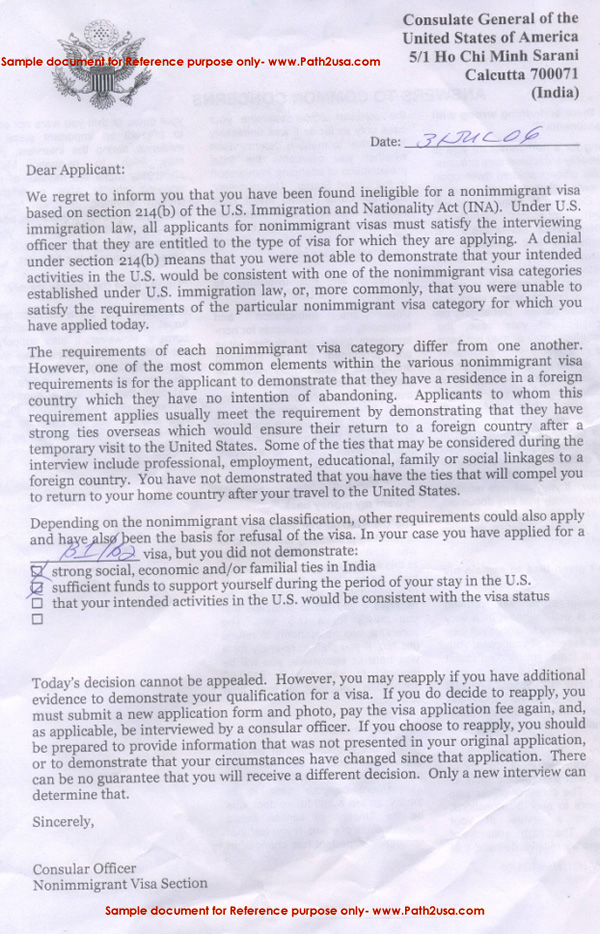
sample-visa-denial-letter.jpgI’m no fan of the U.S. Department of State’s policies and actions in the immigration space.  State’s approach, as manifested by the behavior of U.S. consular officers and the apparatchiks within the Visa Office at the Bureau of Consular Affairs, too often comes off as a mix of treacly haughtiness and callous indifference.

These Ugly American attributes are the foreseeable consequence of the grant of unbridled power. Straight-shooters call this power “consular absolutism” while the decorous dub it “consular nonreviewability.” First established as a temporary, war-time measure in 1918 and then incorporated into current law by a McCarthy-era Congress that overrode President Truman’s veto in 1952, the power of a single consular officer to determine the facts and refuse a U.S. visa cannot be overruled; not by the courts, the Attorney General, the Secretary of State or the President.

To be sure, sometimes State does the right thingKudos to Hillary Clinton for using the immigration law to promote U.S. foreign policy objectives, as she did recently in allowing consuls to grant Iranian students multiple-entry two year visas, thereby supporting the Iranian people over their goverment. At other times, however, State stumbles and the hopes of countless innocent folks crash. Consider, for example, State’s recent flubbing of the visa lottery selection process. Other pratfalls happen all too often, none more noticeably than missteps advertised in a much-watched State online resource, the Visa Bulletin.  Obscure to most Americans, the Bulletin tells watchfully waiting immigrants and their sponsors (American families and firms) how much or little, if at all, the “cut-off date” on the immigrant visa (green card) quota will move forward in the next month. 

The movement of the immigrant visa quota is less a math formula than a guesstimate.  A well-intentioned and competent State Department official analyzes reports of immigrant visa usage by consular officers (this is the easy, mathematical part), then grapples with the hard part — the unpredictable flows of green-card issuance data from U.S. Citizenship and Immigration Services (USCIS) — and then tries to estimate the rate and volume of future USCIS grants of green cards (adjustments of status, or AOS).  The problem is that AOS grants are approved at several locations (the USCIS regional service centers and field offices and the courtrooms of the DOJ’s Immigration Judges). 

Although Congress contemplates a FIFO (first-in, first-out) quota system under Immigration and Nationality Act §203(e), seasoned observers have reason to believe that what really happens behind the scenes at USCIS is much more of a catch-as-catch-can system. AOS files are housed and distributed helter-skelter in a USCIS salt-mine storage facility in the midwest, regional service centers, ICE attorney file cabinets or shopping carts wheeled between immigration courtrooms, and USCIS field offices.  Although a recent lawsuit and motion for preliminary injunction in Seattle federal court challenging the immigrant visa (IV) quota allocation system failed, apparently for reasons urged by the government, this has not stopped ever-louder public complaints.

In recent years, the quotas dramatically and unexpectedly moved backward (retrogressed) twice  — in 2007 under the employment-based immigrant visa categories, and in January this year under the family categories — thus adding years more to the wait.  Although this might please the anti-immigration crowd that crows about the supposed honor of doing things legally by “waiting in line” (while silently celebrating that law-abiding immigrants are kept out), it hurts American interests.  American families are needlessly separated and the ability of U.S.businesses to compete on the global stage is hamstrung, while immigrant innovations that might have been are needlessly delayed or never happen.

Much of this harm could be avoided or lessened by President Obama, and virtually all of it could be eliminated by a willing, America-first Congress.

The President could take a lesson from Disneyland and the airlines — businesses that know something about people waiting in lines.  These businesses know that opportunities for profit and reduction of complaints can arise even while customers wait (see Disney’s techniques here and here; see airlines’ approaches here).

  • For intending immigrants waiting abroad, President Obama could remind State and its consular corps that wannabe green card holders, despite their desire to immigrate, are still eligible under law for all manner of nonimmigrant visas, and should be granted such status liberally in deserving cases.  I’m not talking about the misnomer that many immigration agencies and uninformed immigration lawyers call “dual intent” visas, as they refer to the H-1B and L-1 temporary categories (which are more accurately described as intent-irrelevant classifications).  No I’m referring to the true dual-intent categories, such as business visitors, tourists, students, exchange visitors and trainees).  The courts and immigration precedent decisions have long ago recognized that a visa applicant or nonimmigrant entrant can have a short-term intention to enter the U.S. presently, yet harbor the desire and intent to attain green card status when and if the law and the factual circumstances so permit, as long as the individual’s overriding intention is to be law-abiding.  If the person, by prior conduct in compliance with immigration law and compelling ties abroad, has an intention to immigration in the future but no intention to break the law by overstaying the period of admission or violating immigration status, then s/he has legitimate dual intent (see cases cited, FN 51).
  • The President could also tighten the reigns on the State Department by instructing the Secretary of Homeland Security to exert the superior authority granted her over immigration matters abroad under the Homeland Security Act, thereby cabining any rogue behavior by State’s consular officers. 
  • For law-abiding nonimmigrants in the U.S., he could — as I noted in my last post — take executive actions that would allow early filing (but not accelerated approval) of green card applications by persons with approved immigrant visa petitions (which would allow international travel and continuing employment permission) and administratively freeze the age of minor children as of the date AOS is filed. 

Our feckless Congress — if they truly cared about American jobs, competitiveness and deficit reduction more than political posturing and electioneering — could also make worthy changes in our national interests:

  • Congress could also accomplish legislatively all of the outcomes noted above that concurrently fall within the authority of the President.
  • Congress could set an example to other countries by putting reasonable procedural due process constraints on consular officers and allowing at least meaningful administrative review and a clear right to in-person legal counsel at visa interviews and administrative hearings.
  • Congress could reap significant revenue by allowing quota line-jumping for a hefty premium fee. You may say this would be unAmerican, but we already allow premium processing at USCIS and provide wealthy investors with faster access to green cards (EB-5 visas) and nonimmigrant visas (E-2 and L-1A) by tendering legal tender.  We live in a capitalist state where theatres, sports teams and concert venues sell premium seats, airlines have first class cabins, and as Ernest Hemingway astutely observed in a misquote of an F. Scott Fitzgerald line: (Fitzgerald: “The rich are different than you and me.” Hemingway: “Yes, they have more money.”)

If you doubt the wisdom of better customer service for immigrants, consider the following excerpt from an unsolicited email I received from a foreign citizen (whose identity will not be revealed) in response to a three-part teleconference series I’m moderating next week (Illuminating the Dark Ages: Disturbing Trends and Pleasing Solutions in Employment Based Immigration):

I tried to get some help from 11 lawyers. Not a single one accepted. One told me that being in the US was a “privilege” and not a “right”. Another one warned me about any action that could irritate the immigration service. The others just answered – when they answered – by one sentence: you have no possibility because there is still two years before your priority date.

As of today, I am still struggling. Why? Because:

– I want to get back to my career

– I want to achieve a degree at the University

– I want to open a business

– I want to buy my apartment

– I have hired 15 American citizens since I am a manager in my company and I think I am not a charge for anybody in the U.S.

But as you guess, I am the only one to believe that I will succeed.

I will conclude my message here, I thought that this story could be an illustration of the precarity of people like me, and I want to mention than I had never felt such a climate of rejection, suspicion and even in some cases, hostility, until this past few months. I had always felt very happy to live in the U.S. Today, the situation has created a daily anxiety, fear for the future and feeling that I am not welcome anymore.

Thank you for your reading. 

President Obama has put on a good show lately about the need for the populace to rise up and pressure the GOP to enact comprehensive immigration reform.  He urges citizens to begin “a national conversation on immigration reform that builds a bipartisan consensus to fix our broken immigration system so it works for America’s 21st century economy.”  With the White House claiming that “he can’t do it alone,” he asks you and me to host  roundtables that will “help bring the debate to your community.” 

Were it not for the Republicans who keep moving the goal posts on border security, he claimed on May 10 in El Paso, we’d be able, together, to devise the grand solution that fixes our nation’s wholly dysfunctional immigration system: 

We have gone above and beyond what was requested by the very Republicans who said they supported broader reform as long as we got serious about enforcement. All the stuff they asked for, we’ve done. But even though we’ve answered these concerns, I’ve got to say I suspect there are still going to be some who are trying to move the goal posts on us one more time. . . . they said we needed to triple the Border Patrol. Or now they’re going to say we need to quadruple the Border Patrol. Or they’ll want a higher fence. Maybe they’ll need a moat. (Laughter.) Maybe they want alligators in the moat. (Laughter.) They’ll never be satisfied. And I understand that. That’s politics.

alligators.jpg

Some may be moved by his crocodile tears to swallow the notion that his hands are tied. I have a few words in response:  Balderdash. Bunkum. Hogwash. Fiddle-faddle.

Either this president is not the analytical, data-gathering, cooly-decisive and valiant leader portrayed by the media, particularly since the takedown of Osama Bid Laden, or, he is playing politics with people’s lives and “America’s 21st century economy.”  There’s no need to repeat previous posts (here, here, herehere, here and there) on his broad executive authority to ameliorate the traumas endured by DREAMers and the other undocumented among us. 

The simple fact, known all too well by immigration insiders but rarely reported, is that President Obama could vastly improve America’s competitiveness and stop the flight of foreign talent back to their homelands by reversing or recalibrating several administrative rules or rulings that have long thrown foreign entrepreneurs into the moat with the immigration alligators.  

Here are some things that President Obama could accomplish immediately, solely by executive action, to allow existing America’s immigration laws to help create jobs:

  • Restore Self-Sponsorship for Working Owners. Since 2010, U.S. Citizenship and Immigration Services (USCIS) has prevented foreign entrepreneurs from receiving an H-1B visa (for workers in specialty occupations).  The agency took this action notwithstanding four precedent decisions, Matter of Aphrodite Investments Limited (1980), Matter of Tessel (1980), Matter of Allan Gee, Inc. (1979) and Matter of M–  (1958), that allowed a foreign citizen to incorporate a business and use the entity to sponsor the individual’s work visa or green card.  The President could easily order USCIS to withdraw the 2010 USCIS memorandum that abruptly strayed from precedent decisions, as the American Immigration Lawyers Association (AILA) has urged. 
  • Restore L-1A Function-Manager Eligibility. The Immigration Act of 1990 (IMMACT) allows managers of essential corporate functions to qualify for an L-1A work visa (for intracompany transferees) and a first preference green card (for multinational managers).  Before IMMACT, only managers of personnel could be granted these benefits.  USCIS routinely denies function-manager requests by claiming that the person does not manage the particular function but primarily performs the function.  This interpretation has rendered the function-manager category a dead letter.  Congress had no need to create the function manager classification in IMMACT if subordinate personnel were to be required to perform the function (so that the function manager could manage it) since a people-manager category already existed. To offer a simple example, a corporate controller under the current USCIS interpretation cannot qualify as a function manager unless the person manages other people — something that controllers rarely do. The President can easily remedy this mistaken interpretation by instructing USCIS that managers of key corporate components and functions are eligible for function-manager designation even if the individual also performs the function.  This would allow foreign entrepreneurs to create new U.S. businesses and start creating jobs for U.S. workers right away.
  • Restore L-1B Specialized-Knowledge Eligibility. The USCIS Office of Public Outreach got an earful of criticism last week from stakeholders urging the agency to revert to longstanding interpretations of eligibility for an L-1B intracompany transferee visa under the specialized knowledge subcategory. In the teleconference, callers explained that the L-1B had been properly interpreted for decades until 2008 when a non-precedent decision of the USCIS Administrative Appeals Office without warning dramatically restricted its interpretation of L-1B specialized knowledge. Here too, the President could swiftly help foreign entrepreneurs create American jobs by restoring their longstanding ability to send key workers with specialized knowledge to the United States. 
  • Expand Schedule A to include “special-merit” foreign citizens.  The Department of Labor (DOL) under its Schedule A regulation has long allowed persons whose skills are in short supply to avoid the labor market test normally required and obtain an employment-based green card. Schedule A now includes registered nurses, physical therapists and persons of exceptional ability. Back in 2002, AILA asked the DOL but the agency refused to expand Schedule A by allowing “special-merit” foreign citizens to immigrate. AILA made this request because the normal labor market rules deprive a wide array of worthy aliens of any opportunity for PERM labor certification.  Individuals in the unwelcome category include investors, entrepreneurs and working owners, and foreign-born employees who are “so inseparable from the sponsoring employer because of his or her pervasive presence and personal attributes that the employer would be unlikely to continue in operations without the alien”.  Under orders from the President, the expanded use of Schedule A for these special-merit foreign citizens would allow fair consideration of deserving cases that have had little or no access to labor certification under the current system.
  • Allow the filing (but not the approval) of green card applications before the visa quota is open. Today, because of quota backlogs and an unfair allocation system, a person born in India holding a university degree, whose employer’s immigrant visa petition has been approved, may have to wait as much as 20 years before being allowed just to file a green card (adjustment of status) application. The wait is only marginally less for those born in China.  During that time, the person’s spouse and working-age children ordinarily cannot work, and the children are at risk of “aging-out” — reaching age 21 and thus losing green-card eligibility. What’s worse, if the foreign worker loses his job in the meantime, the whole immigration sponsorship process (if the family involved has the stomach to pursue it) must go back to square one. As much as America may otherwise be attractive to foreign entrepreneurs and key workers, no sane person would find the risk and limitations of these waiting periods enticing.  In a New York minute, if he were so inclined, President Obama could make the wait more tolerable.  All he’d need to do is instruct USCIS to accept for filing adjustment applications for the beneficiaries of approved immigrant visa petitions and issue a rule freezing the dependent children’s age as of the date of filing the green card application.  This way, in the interim until the quota is current, the spouse and working-age children could work or study, and the foreign employee would not be tempted to give up on America, return home and compete against us.

President Obama is no fool.  He understands the link between immigration, innovation and job creation, as he explained to the crowd in El Paso:

[O]ur laws discourage [foreign students educated in the U.S.] from using those skills to start a business or a new industry here in the United States. Instead of training entrepreneurs to stay here, we train them to create jobs for our competition. That makes no sense. In a global marketplace, we need all the talent we can attract, all the talent we can get to stay here to start businesses — not just to benefit those individuals, but because their contribution will benefit all Americans. 

Look at Intel, look at Google, look at Yahoo, look at eBay. All those great American companies, all the jobs they’ve created, everything that has helped us take leadership in the high-tech industry, every one of those was founded by, guess who, an immigrant. (Applause.) 

So we don’t want the next Intel or the next Google to be created in China or India. We want those companies and jobs to take root here. (Applause.) Bill Gates gets this. He knows a little something about the high-tech industry. He said, “The United States will find it far more difficult to maintain its competitive edge if it excludes those who are able and willing to help us compete.” 

So immigration is not just the right thing to do. It’s smart for our economy. It’s smart for our economy. (Applause.) And it’s for this reason that businesses all across America are demanding that Washington finally meet its responsibilities to solve the immigration problem.

Why does the President wait for Congress to act when he has his executive pen in his pocket?  Why should immediate job creation be held hostage to Washingtonian impasse, when the job-eating immigration alligators under his control can be easily restrained?  I’m no politico, but it’s politics, I suppose.

Our government leaders often ignore elementary rules of ecology and economics when trying to grapple with America’s immigration problems.

Ecology teaches that a system cannot thrive or long function if inputs far outnumber outputs. When rainwater enters the Mississippi in a volume that exceeds the river’s carrying capacity, levees are breached, adjacent lands are flooded, and people are devastated.

Economics teaches that because we live in a world of scarce and finite resources, a more or less functioning system of resource allocation will perforce arise. Not every one of the world’s inhabitants can sport a watch made of gold when this precious metal breaches the $1,500 per ounce price point, as has occurred recently. Thus, some mode of gold-watch allocation (be it capitalism, communism, despotism or another form of wealth transfer) will inevitably surface. The same or a similar system inevitably develops to allocate food, water, clean air and the real necessities of life.

Consider then the interplay of ecology and economics as the Federal Government tries, but mostly fails, to deport foreign citizens whom Congress has declared, in a very long list, are undesirable. The process is broken and dysfunctional because ecology is ignored (many more persons are brought before immigration judges and ordered deported than actually forced to leave) and economics is given short shrift (deportation resources are not targeted to first remove the most dangerous or vile offenders).

Deportation system breakdown, like success, has multiple fathers:

 Notice to Appear.jpg

  • A multitude of reasons to require leaving. The grounds for deportation (or “removal,” as it is technically known) range widely. Included are evildoers (such as terrorists and human predators), economic migrants (if they are without proper papers), and the unlucky or merely careless (the unfortunate, if capable, souls who are fired from a job for which a work visa had been issued; those who’ve unwittingly exceeded their required departure date by even just a day or a week; or, persons whose request for permission to stay longer than initially planned has been denied). 
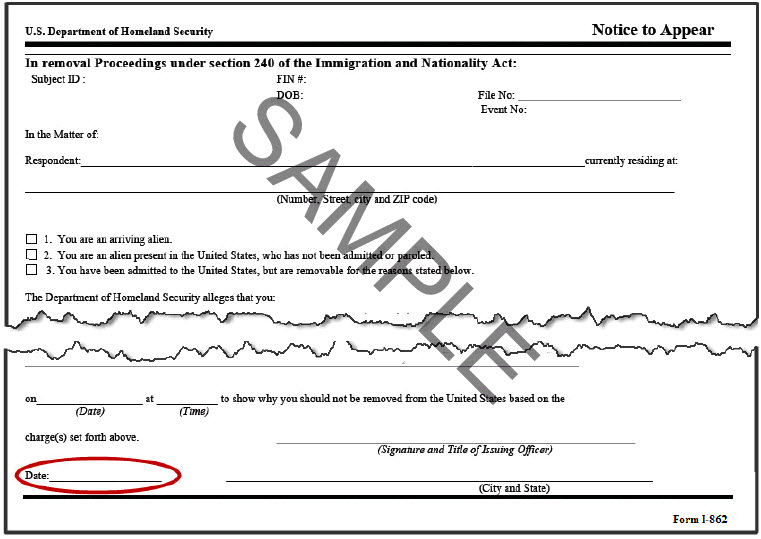
  • Too many ticket printers. Multiple officials within various units of the Department of Homeland Security (DHS) exercise authority to start the deportation process by issuing a Notice to Appear (NTA) at a removal hearing before an immigration judge (IJ). These include the Border Patrol, within Customs and Border Protection (CBP), adjudicators employed by U.S. Citizenship and Immigration Services (USCIS), and the deportation police at Immigration and Customs Enforcement (ICE). Surprisingly, with CBP, USCIS and ICE all issuing NTAs, there are no published statistics, by issuing authority, on the numbers or percentage of newly opened immigration cases destined to appear before the immigration courts. This is a case of the left hand, the right hand and the other right hand not knowing what their counterparts are doing.
  • No bouncers. DHS has not established an orderly and intelligently-designed system to determine the integrity and propriety of each NTA that has been issued.  No designated official systematically decides which NTAs should or must be filed with the immigration court, and which ought be held in abeyance or disposed of in one of several non-judicial ways. (Almost every NTA, although styled as a “notice to appear” before a judge, contains no courtroom and date certain for the convening of a removal hearing. Instead, the document states factual allegations and legal grounds for removal and tells the person receiving it that the date and place of hearing will be announced in a future notice.) The system as presently operated requires no formal screening of NTAs to determine whether each is legally justified and sufficiently serious to warrant a hearing before a judge, potential incarceration, appellate review, and actually-enforced removal from this country. Clearly, some NTAs should be rejected. Why schedule an IJ hearing for a more-than-six-months, less-than-a-year overstay who can avoid the blotch of removal and a three-year-bar to reentry by complying with an administrative order of voluntary departure? Why waste an IJ’s time if the obvious resolution is to let time pass and await the individual’s turn in the green-card queue?
  • No ushers. Only a finite number of NTAs can be processed to the point of actually removing the person to his or her country of origin. This is not just an example of the theoretical principle of prosecutorial discretion. It is a rational system of ecological management (refraining from flooding the system beyond its carrying capacity) and economic realism (allocating scarce resources of money, time and energy to process only the most compelling cases for actual removal). 
  • Too few referees with too little power. Without appointing more IJs (and providing other required resources, like courtrooms, detention facilities, interpreters, law clerks, etc.) the over-issuance and over-filing of NTAs with the courts create the reality of assembly-line (in)justice and the illusion that the removal laws are carried out. Either the IJs should be given more authority to terminate proceedings where NTAs are improvidently issued or grounds for relief from removal are best handled outside the immigration courts, or, Congress must allocate sufficient judicial resources to accommodate the flood of NTAs.

* * *

Our federal lawmakers and the Obama Administration need to be told by Progressives, Tea Partiers, frugal independents and traditional partisans that the innumerable NTAs and outstanding but unfulfilled orders of removal flooding our deportation system mock both the duty to make and execute the laws faithfully, and proven principles of ecology and economics. We simply cannot and should not deport everyone for whom a technical ground of deportation can be cited. Some we should allow to stay, because they exemplify our values and their presence enriches us. Others who are really bad must go. A wise polity knows and acts on the difference.

The attention given the Obama Administration’s expanded use of aerial drones (of late in Pakistan, Yemen and Libya, at the U.S. border, and perhaps over other points unknown) to bombard unsuspecting targets and predictably, if not wilfully, cause civilian casulaties, may have distracted predator drone.jpgfrom other important meanings of the word.  Webster’s Dictionary defines “drone” in four distinct ways:

1 : a stingless male bee (as of the honeybee) that has the role of mating with the queen and does not gather nectar or pollen

2 : one that lives on the labors of others : PARASITE

3 : an unmanned aircraft or ship guided by remote control

4 : DRUDGE . . .

Surprisingly, all four definitions, literally or figuratively, apply to recent action of the Department of State in unleashing a veritable arsenal of consular drones into the immigrationsphere on April 27. The DOS’s surreptitious bomb droppings involve a far-reaching final rule issued without the usual forewarning of published notice and the opportunity for public comment as contemplated under the Administrative Procedures Act (APA).  Claiming that the rule is exempt from APA formalities, State (with signoff by Janice Jacobs, Assistant Secretary for Consular Affairs) proclaimed by ipse dixit a regulation expanding the authority of American consular officers to revoke U.S. visas previously issued to foreign citizens.

Typical Paparelli hyperbole, you might say, associating pilotless bombers that kill and maim with a dry rule published in the Federal Register.  Let’s see.

Drone%20Bee.jpgVisa officers — of both genders — are mated to, and serve and service, the hive that is State (definition 1), although admittedly they are not “stingless,” as I’ll soon show. Their unwarranted visa refusals and revocations suck out the lifeblood of family unity and entrepreneurship that nourishes this Nation of Immigrants (definition 2). Too often thoughtlessly, they do the bidding of distant masters at State and Homeland Security, and are therefore reliably compliant in a Disney animatronic sense (definition 3).  And their work is unrlenting drudgery, given that State allows them just minutes to decide the destiny of visa applicants, no less decisively than a set of fast-closing subway doors determined the alternative fates of the characters in the 1998 film Sliding Doors (definition 4).

I’ve railed before, quite often and at length, about the harm to American families and firms caused by the unregulated power of U.S. consular officials to deny visa applications of deserving foreign citizens (to review my prior rants, the curious need only type the words “visa refusals” in the search box to the right). Still, this new drone attack is insidious in several ways:

  1. Whimsy’s Silent Death Knell. The final rule allows immigrant and nonimmigrant visa revocations in the consular officer’s (potentially whimsical) discretion, whereas the prior regulations (see the IV rule and the NIV rule) made the decision purely one involving straightforward findings, of fact and and under law, that the applicant was not or is no longer eligible for the visa. Presumably, the new regulation supplants State’s Foreign Affairs Manual (FAM) provision denying consular officers the “authority to revoke a visa based on a suspected ineligibility, or based on derogatory information that is insufficient to support an ineligibility finding.”  Previously, consular officers had no power (only State had the authority) to decide so-called “prudential revocations” which according to the current version of the FAM, “simply reflect that, after visa issuance, information surfaced that has called into question the subject’s continued eligibility for a visa.”
  2. Shut My Mouth. The final rule removes any express opportunity for the applicant or his/her attorney to present evidence to confirm that the inividual is legally entitled to keep the visa under immigration law.  Instead, the new rule provides that consular officer “consider . . . information related to whether a visa holder is eligible for the visa.” 
  3. No Chance to Scream. Nothing in the final rule requires the consular officer to allow the applicant or counsel to inspect and rebut “derogatory information unknown to the applicant,” unlike the USCIS regulation, 8 CFR § Sec. 103.2(b)(16), which grants this customary due process protection.
  4. Shoot First, Ask Questions Later. The final rule creates an illusory “provisional revocation” process that is indistinguishable from an unconditional revocation, namely, the immediate nullification of the visa for use in traveling to the United States. The former regulations required the consular officer, if practicable, to issue a notice of proposed revocation and thereby allowed an opportunity for rebuttal or reconsideration before the actual revocation took place.
  5. Queen Mother Bee, May I? The new rule relieves the consular officer of the duty in several types of cases to seek State’s prior permission in the form of an Advisory Opinion.  Now a consular officer, without hesitation or consent, can uncap and click the visa revocation button and fire off a drone.  
  6. ‘Tain’t Fair. Consular officers now have authority under the final rule to revoke a visa even if the visa holder is already in the United States — an action that heretofore only State could do under the present version of the FAM. Under Immigration and Nationality Act § 221(i), a consular revocation cannot be reviewed by any court except in limited circumstances during a removal (deportation) hearing. Thus, a consular decision, perhap made on incorrect information and without notice to the visa holder or a rebuttal opportunity, transforms an otherwise law-abiding foreign citizen into a deportable alien whose only remedies are to be hauled before an immigration judge or hop on the first flight back home.

Even before State’s fait accompli drone attack, the DOS recognized and forewarned consular officers to “be alert to the political [and] public relations . . . consequences that can follow a visa revocation,” noting in the FAM that the “revocation of the visa of a public official or prominent local or international person can have immediate and long-term repercussions on our political relationships with foreign powers and on our public diplomacy goals in a foreign state.” Apparently, visa revocations involving lesser known foreign figures are of inconsequential concern to the Department.

I’ll end my droning with a suggestion to State: 

Superman.jpgIf you care about our nation’s image in the world and the soft skills of diplomacy, as you oft proclaim, withdraw this silly and pernicious rule. Contrary to your bald assertions in the preface to the rule, your release of immigration drones will inevitably trigger “adverse effects on competition, employment, investment, productivity, innovation, [and] the ability of United States-based companies to compete with foreign based companies in domestic and import markets.”  Your rule also raises the prospect that families of “little people” — to snatch a phrase from the “Queen [Bee] of Mean,” Leona Helmsley — will be torn apart by your improvidently released drone attack on fair play and simple justice. 

With your actions as added martial fodder, is it any wonder that Superman is renouncing his U.S. citizenship because he cannot in good conscience continue to link truth and justice to the American way?     

A trip abroad, as I took recently for a speaking gig, often allows intellectual curiosity to gallivant more freely.  It also provides opportunities to question accepted truths or cause germinating notions to blossom into convincing arguments, especially if serendipity or divine providence creates chance meetings with strangers.  These thoughts crystallized after my return as I read Peggy Noonan’s op-ed piece in the April 23-24 Wall St. Journal, “What the World Sees in America.”  She wrote: 

[There] are . . . reasons for a new skepticism about America’s just role and responsibilities in the world in 2011.  One has to do with the burly, muscular, traditional but at this point not fully thought-through American assumption that our culture is not only superior to most, but is certainly better in all ways than the cultures of those we seek to conquer.  We have always felt pride in our nation’s ways, and pride isn’t all bad.  But conceit is, and it’s possible we’ve grown as conceited as we’ve become culturally careless.

Which brings me to the point of this post. I need to debunk a curious and obscure creation of the federal courts, a particularly perverse form of “American Exceptionalism” (itself, a distasteful term which I must flavor with a boulder’s worth of granulated salt to get it down the gullet).  The construct of the federal courts that I’m about to describe rests on tottering and false assumptions.  These are (a) that administrative agencies, in particular, federal immigration agencies, possess superior expertise in interpreting the enacted laws which they administer, and (b) that therefore courts should abdicate responsibility for interpreting these laws and defer to the agencies’ presumably learned prowess in the art of statutory interpretation. 

(Before challenging the courts’ concoction, I note my displeasure with the conceit – pun intended – of American Exceptionalism, most often a proxy for undeserved arrogance or fact-free opinion.  Yes, in times past we have shown ourselves to be a great nation, as, for example, the Marshall Plan, created by our forbears, that saved Europe after World War II – a laurel on which today’s younger Americans undeservedly rest – or the Civil Rights Movement, which planted seeds that allowed a biracial American to become the nation’s president.  Also a feature more of the past than the present is America’s tradition as a welcoming nation of immigrants, a form of Exceptionalism that I unhesitatingly extol.) 

The high- (or, in my view, low-) water mark for judicial deference to presumed administrative-agency expertise is the Supreme Court’s Brand X decision, an aptly titled case for TV viewers of 1960s-era commercials who know that the name refers to a decidedly inferior product. Brand X held that the federal courts must yield to an administrative agency’s legal interpretation if the words of a statute are ambiguous.  As Carl Sandburg taught, the words of statutes, when read by trained legal and judicial minds, virtually always can be interpreted as ambiguous.  Thus, the courts are under orders to let the agencies call the shots. 

So, do immigration agents in the Departments of State, Labor, Homeland Security and Justice really possess special expertise, greater than the courts, in divining the elusive intent of Congress whenever our federal legislature has passed immigration laws?  My 30-plus years as an immigration lawyer compel me to shout a “NO” answer. 

Alfred-E-Newman.jpg

Here’s why. America’s immigration agencies are silos, each spewing forth legal assertions from their prescribed parcels of the expansive turf that is the Immigration and Nationality Act (INA).  The Labor Department (DOL) may claim arguable expertise with immigration-related laws protecting the wages and working conditions of American and foreign workers, but it (like the other agencies, as I’ve noted in a prior post) has an axe to grind, rather than a mandate of blind justice in administering immigration laws.  DOL deserves no presumption of expertise about the multiple forms of statutory eligibility needed to procure immigration benefits (the domain of U.S. Citizenship and Immigration Services [USCIS] within the Department of Homeland Security [DHS]) or to obtain immigrant or nonimmigrant visas (the province of the State Department operating under a Memorandum of Understanding [MOU] with DHS).  The converse is also true, as USCIS readily admits

Similarly, two DHS police units – Immigration and Customs Enforcement (ICE) and Customs and Border Protection (CBP) – are charged, respectively, with removing or excluding foreigners who have violated or are likely to break the immigration laws.  Strangely, however, these federal cops play a comparatively small role in declaring which activities fall within or outside the statutorily complex principles of lawful “immigration status” and valid employment authorization.  These instead are functions that USCIS (more or less) discharges concurrently with a variety of Justice Department units (the Executive Office of Immigration Review, comprised of the Immigration Courts and the Board of Immigration Appeals, along with the Office of the Chief Administrative Hearing Officer and the Office of Special Counsel for Unfair Immigration-Related Employment Practices [OSC]). 

As post-9/11 “connect-the-dots” studies and Congressional hearings have taught us, and as most immigration lawyers already knew, the several federal immigration bureaucracies tend to protect their turf, and often distrust and positively dislike and disrespect their counterparts in sister agencies.  Worse yet, they typically prefer a cloistered existence rather than one that reaches out across the Executive Branch in patriotic efforts to harmonize and declare in unison a reliable set of interpretations of America’s immigration laws and policies. 

Lately, seasoned immigration observers have noticed a kind of Hatfields-and-McCoys détente in which interagency MOUs proliferate (as illustrated by the DOL-DHS MOU, the USCIS-OSC MOU, the DHS-State Department MOU and the impossible-to-exit and falsely promoted ICE Secure Communities MOU). Close readings of these MOUs reflect a desire by the various agencies to seek reciprocal non-molestation pacts and avoid tripping over one another, or to gull state and local authorities, rather than to provide harmony and transparency in the interpretation of the immigration laws. 

These types of governmental MOUs were never mentioned in my high school civics class, or in any course I took on administrative law.  They are an affront to Congressional power and a testament to legislative lassitude over immigration.  Such bureaucratic faux-contracts, when coupled with the fawning deference ordered by the Supremes in Brand X, resemble more a French farce about institutional asylees who assume governmental roles a la the 1966 film King of Hearts, than a just, reliable and orderly exercise of federal power in the immigration sphere.  As Peggy Noonan concluded in her op-ed: 

The whole world is . . . judging what it sees [of America], and likely, in some serious ways, finding us wanting.

And being human, they may be judging us with a small, extra edge of harshness for judging them and looking down on them. 

We have work to do at home, on our culture and in our country. 

It’s been desiccation junction everywhere in the nation of immigrants. Week-long fears of a government shutdown (averted nearly at the witching hour, midnight on April 8) seemed to suck the air and the attention spans out of official Washington.  A volunteer army of lawyers, descending on the Capitol for a National Day of Action to fix America’s broken immigration system, heard most legislators, Administration officials, and their staffs dampen expectations: There would likely be no let-up in detentions, removals and worksite enforcement, and no legislative action or administrative relief on comprehensive immigration reform until after the 2012 elections. 

To accentuate the point, Immigration and Customs Enforcement (ICE) served a notice to appear for a removal hearing on Prerna Lal, an outspoken DREAMer, just as she blogged that “Obama Issues A Gag Order On ‘Stop the Deportation’ Campaigns.”  Heaven forfend that the President be called to account for his broken promises on immigration as he seeks Latino help to secure a new lease on the Oval Office.  Ironically, the State Department in its release this week of its Annual Country Reports on Human Rights Practices, although referring to the actions of foreign governtments, aptly described what happened to Prerna: “[H]uman rights defenders are singled out for particularly harsh treatment.”

The week also signaled continued frailty in the economy as U.S. Citizenship and Immigration Services (USCIS) announced that it had received just over 10,000 H-1B visa petitions for foreign workers in specialty occupations (about 5,900 petitions counting toward the 65,000 cap, and roughly 4,500 petitions toward the 20,000 cap for holders of advanced U.S. degrees). The H-1B visa quota has been an accurate lodestar for the health of the economy, rapidly depleted when the good times would roll, and slow to run out when times are less robust. [See this Jan. 2011  GAO Report, Page 15, Figure 6: Time to Reach Annual Cap and Cap Level, Regular and Master’s Cap, FY 2000–FY 2010.]  Apparently even an upsurge in high-tech hiring did little to move the H-1B needle.

Meantime, journalists reported that the nation’s immigration judges are facing burnout and compassion fatigue (with at least one judge on antidepressants and seeking psychological help) as the system of assembly-line injustice acts like a wood chipper on overdrive, grinding up citizens and immigrants with equal disdain.

Maybe it will take another way of understanding the facts. Perhaps a documentary film can touch the heart and the head when pleading and logic fail. Neither inflammatory nor melodramatic, or one-sided, this film Undocumented depicts real people whose lives are in torment by Washington’s failure to fix the eminently fixable immigration laws.


If not film, then possibly prayer from the psuedonymous patriarch in Undocumented:

My Lord, bring peace to this country.

They are putting [in] many strict laws.

Not just against Hispanics but against all.

My Father, I pray you soften the hearts of these lawmakers.

Soften their hearts and make them sensible, my Lord.

Make them see, we are human, just like them.

And they need not attack us, and destroy families.

The children are the future of this country.

Change their minds and transform them.

And one day they will come to know your true love.

We pray for Austin [Texas] my Lord.

We ask for you, Father, to transform them.

And we ask for your blessings and guidance.

Oh, and another noteworthy thing happened this week.  On April 8, Sidney Lumet, film director with a social conscience, passed away.  He immortalized the line, which just as well might have been referring to immigration, “I’m as mad as hell and I’m not going to take this anymore!”  He also wrote:

[The] kind of film in which I believe goes one step further [than mere entertainment].  It compels the spectator to examine one facet or another of his own conscience. It stimulates thought and sets the mental juices flowing.

In the best Lumetian tradition, let’s hope that Undocumented does just that. 

On the first day of the second quarter of 2011, I fell for a joke.  As the Urban Dictionary (definition #2) would word it, I was “punk’d“!  I didn’t merely fall for just any immigration-related ersatz news item (like the passage of the CIRAF bill reported by my colleagues in ABIL), I breathlessly embraced as the truth an emailed report I quote below and forwarded it to an immigration reporter for a prominent newspaper, asking if the reporter would like a quote from me on this “big news.”

Written by an author who knows immigration parlance and the real names and titles of immigration agency officials, the disinformation that gulled me was this:

April 1, 2011

Washington, DC – U.S. Citizenship and Immigration Services (USCIS) announced today relief for tens of thousands of people caught in long waits for immigrant visa availability. USCIS Director Alejandro Mayorkas said in a statement “These people have been living in a state of limbo in the United States for too long.”

This program is initially going to be targeted at immigrants who have an approved “I-140 Immigrant Petition for Alien Worker” filed on their behalf, but cannot receive permanent residence because of backlogs in immigrant visa availability.  The new “Conditional Resident” status will be extended to such individuals who have had approved petitions filed on their behalf, and who have waited at least one year for availability of an immigrant visa. The Conditional Resident status will extend the same rights as Lawful Permanent Residence with two conditions: 1) Status will be extended for periods of 3 years, renewable indefinitely, and 2) Status will conditional on an immigrant visa not being available to the holder. Once an immigrant visa is available, the Conditional Residence will automatically be converted to Lawful Permanent Residence without further application being required by the immigrant.

James McCament, Chief of the Office of Legislative Affairs indicated that this change will take place by an administrative rule change, and that a Notice of Proposed Rulemaking (NPRM) should be published with the details of the proposed new status within the next 30 days. After a comment period, the new rule will take effect 60 days after publication in the Federal Register.

For more information, please contact the USCIS Office of April Fools at aprilfool@mailinator.com.

Similarly, recent immigration news — regrettably, 100% reality-based — suggested an April Foolsy, all-too-incredible quality.

On the enforcement front, a former Assistant Chief Counsel of U.S. Immigration and Customs Enforcement (ICE), Constantine Peter Kallas, perhaps wishing that he were merely a fictional character in an April Fool’s prank, received a 17-year sentence and a $297,000 fine following his conviction “for taking bribes to help immigrants fill out false paperwork to remain legally in the country.”

In the Executive Branch, both President Obama and his Homeland Security Secretary, Janet Napolitano, despite chants both minstrel and a cappella, threw ICE water on the notion that executive authority and administrative remedies might be used instead of police powers to provide even a fitful respite from the Administration’s precedent-setting record of deporting foreign citizens largely without criminal records.  Unwilling to use the executive authority and discretion he clearly possesses, the President perhaps should consider adopting the robotic approach to immigration and border security now in a testing phase abroad.

Although Secretary Napolitano maintained that DREAM-Act-eligible students are not a priority enforcement target, neither explained why the extraordinary executive remedy of “parole in place” was used on a blanket basis as recently as in the last 12 months (with nary a peep from Congress) to help foreign citizens of the Commonwealth of the Northern Mariana Islands who just as innocently as the DREAMers violated the immigration laws. Nor did the President explain (despite his claim of thinking about jobs upon rising in the morning and retiring in the evening) why he has not endorsed the Startup Visa Act, a bill that a knowledgeable staffer for Republican Senator Richard Lugar predicted has “almost no chance of passage” unless the White House supports it.

In Congress, another form of unreality was on display at a hearing Thursday of the House Judiciary Committee’s Immigration Policy subcommittee. The hearing considered whether the H-1B visa category was (select one:) too generous/too restrictive and whether we should (select one:) grant/not grant more green cards for tech workers.  Trying to achieve synthesis among competing views, House Judiciary Committee Chair, Lamar Smith (R. TX), offered prepared remarks in which he noted: 

Foreign workers are receiving H-1B visas to work as fashion models, dancers and as chefs, photographers and social workers . . . There is nothing wrong with those occupations, but I’m not sure that foreign fashion models and pastry chefs are as crucial to our success in the global economy as are computer scientists . . .

Tell that to viewers, judges, creative crew and participants in the popular, economically-vibrant TV shows, America’s Next Top Model, Top Chef, So You Think You Can Dance, and Dancing with the Stars, and the less familiar but promising, Talk Therapy Television. Moreover, these are strange words indeed from a Republican about the H-1B visa (a $3 billion government-revenue generator) since the GOP claims to want to minimize regulation and refrain from trying to direct the economy.

On the hustings, at “a conservative conference last week organized by immigration hardliner Rep. Steve King . . . several possible GOP candidates present (Mississippi Gov. Haley Barbour, former House Speaker Newt Gingrich, even Rep. Michele Bachmann (R-Minn.)) didn’t want to talk about immigration. Perhaps, the GOP is at last smelling the Hispanic java, demographically speaking.

Given these verisimilitudinous developments, I hope readers will forgive me for my (hopefully fleeting) naïveté.  After all, if Rip Van Winkle had not fallen asleep and then awakened during the Revolutionary War era, but had instead slumbered at about the middle of the last century and awakened today, he too would have concluded that nothing whatsoever changes about the U.S. immigration system, a broken process that perpetually “draw[s] . . . borders with pens that split lives like an ax.”


[Blogger’s note:  Today’s post is written by my colleague and friend, Karin Wolman.  Karin’s latest guest post,  like her last one, available here, critiques USCIS policy changes that adversely affect the use of the O-1 visa category by artists and entertainers.  When her last post was published on this blog, I was soon contacted by a senior USCIS official who expressed discomfiture and disappointment from the repurcussions her post caused for the agency.  Let’s see how the USCIS responds this time.  I’m happy to give an agency spokesperson equal time on this blog to reply. ]   


Based on public outcry from the arts community and the immigration bar, US Citizenship & Immigration Services has sought to engage stakeholders in a dialogue in order to understand why their policy memorandum of November 2009 regarding agents serving as O-1 petitioners  was not well received, and why their ongoing, ever-narrower “clarifications” reinterpreting the regulations are so unpopular with the industries that rely on the O-1 visa. In short, that memo has substantively changed the interpretation of existing law and regulations, and it added new requirements not supported by the regulation, even though the regulations themselves have not been amended nor revised since adoption of the O-1 Final Rule in 1994. As a consequence, the landscape for O-1 visa sponsorship has changed dramatically.

The most recent opportunity for stakeholder feedback on Agent-as-Petitioner issues was provided by the USCIS Office of Public Engagement in a stakeholder teleconference on March 24, 2011. Some questions were answered, many remain unanswered. Speakers intimated that forthcoming answers in an as-yet unpublished Executive Summary may be even more unpopular and may further destabilize industries already facing serious economic challenges. The most alarming reinterpretation suggested was that USCIS may start to consider O-1 performers to have violated status if they have accepted any new engagements with any “employer” not named in the original petition, even though the regulation at 8 CFR 214.2(o)(2)(iv)(D) explicitly says, “In the case of a petition filed for an artist or entertainer, a petitioner may add additional performances or engagements during the validity period of the petition without filing an amended petition.” If USCIS pursues the suggested interpretation, it will upset almost two decades of settled practice, and would render nearly every O-1 actor, dancer, musician and singer out of status when they seek to extend stay, renew their visa or file for a change or adjustment of status.


The crux of the difficulty is the Service’s insistence on trying to create formulaic and rigid rules for a visa classification whose primary usefulness has been its flexibility, and has highly subjective legal standards, which have allowed individual adjudicators to apply their real-world knowledge and common sense. The consistency so dearly cherished and sought after by agency hobgoblins has led to “clarifications” and “interpretations” that turn long-established agency practice on its head, and destroy well-settled expectations in the professional communities that rely most heavily on the O-1.


Briefly, an “agent” in the O-1 visa context may be a US entity formally in business as an agent or business manager, e.g. providing artist representation; or it may be one among several prospective US employers/presenters/entities that wish to engage the services of the beneficiary (“Agent performing the function of an employer”), or it may be an unrelated party in the US that has a tax identification number and is authorized by the employers/presenters/entities that wish to engage the services of the beneficiary to serve as their agent -solely for the limited purpose of filing a visa petition to facilitate these engagements. 


As indicated by the preceding paragraph, many problems in USCIS attempts to achieve consistency in interpreting the O-1 regulations stem from use of the words “employer” or “employment.”  Those words often do not accurately characterize how work is done in fields of endeavor for which the O-1 visa is used. Although they get paid, most professional athletes in non-team solo sports, most fine artists and performing artists do not usually work in an employer-employee relationship. This is not rare, arcane knowledge: many Americans know when they go to the movies that the actors are not salaried employees of the film studio, but get a flat fee per film, or union scale rates for the time worked. When they buy a CD, they know that Lady Gaga is not an employee of the record label. When they watch a pro golf tournament, they know that Tiger Woods doesn’t have a boss. Apparently, USCIS has distanced itself from common sense understanding of how these industries work, and adjudicators are being asked to set aside their real-world knowledge and apply formulaic standards of “employment” to industries where an employer-employee relationship is not the norm. This is particularly sad and disturbing because the fact that there are many types of work in the arts and entertainment that do not fit the traditional employer-employee model was a foundational reason for the creation of the O and P visa categories in 1991.


The Service’s attempts to characterize all working relationships as “employment” have done considerable damage to the O-1 visa category already, and appear likely to do more, particularly in the context of O-1 petitions by an agent.


Requirements for a petition by an agent now include:

1)      A written itinerary of confirmed engagements, including dates, addresses, rates of pay, etc.;

2)      Contracts between employers/presenters and the foreign beneficiary;

3)      Written consent for the agent to serve as visa petitioner from all other employers/presenters listed on the itinerary;*

4)      Contract or summary of oral agreement between agent & foreign beneficiary.

Requirements 1, 2 and 4 are contained in the O-1 regulations exactly as they have existed since the Final Rule published in 1994, although interpretations of the regulations have changed considerably in the past three years. The written consent requirement is not authorized by regulation (lawyers call this ultra vires), and it creates another burdensome addition to the growing ream of paperwork required for artist sponsorship. Form I-129, until recently 4 pages, has mushroomed to 7 pages; the O/P Supplement, previously only 1 page, is now 2 pages. The thinking behind this agent-consent requirement is foggy at best. When the agent- petitioner already has to provide the contracts for each engagement, what is gained by also requiring a separate document from each presenterconsenting to the agent’s service as visa petitioner?  Does USCIS really think the agent could otherwise have obtained the contract details by stealth, without the consent and cooperation of each presenter?

Neither O-1 regulations nor the November 2009 policy memo require the contracts between employers and beneficiary to be signed – a good thing, as that would effectively kill off the possibility of any foreign artists touring in the US, since lead time for signed contracts inthe performing arts is extremely short. Indeed, as long as all the material terms of agreement are spelled out at least roughly – type of work to be performed, where and when, for what compensation – and if there is as yet no formal written contract, the version of the agreement furnished with a visa petition may be a brief Summary of Oral Agreement laying out all these terms, but it need not be not signed by either party.

However, an O-1 petitioner must also obtain advisory opinions from the relevant labor unions in any field where there is one, and this covers all the performing arts. The number of unions that must be consulted depends on the type(s) of work offered in the US. Some unions have more stringent requirements than USCIS. Notably, O-1 petitions involving aliens of extraordinary achievement in film and television must always include at least two union consultations – one from a labor organization, such as the Screen Actors Guild or the American Federation of Television & Radio Artists, and one from a management organization, the Alliance of Motion Picture & Television Producers.  AMPTP requires all contracts or deal memos to be signed, effectively ratcheting up the documentation standard.

With regard to the itinerary and supporting contracts, for a while (in late 2009 and early 2010) USCIS was automatically sending a Request for Evidence in any O-1 petition where there was a gap in the proffered itinerary of 45 days or more. That practice and policy was formally withdrawn per a USCIS memorandum of July 2010, but adjudicators retain broad discretion to request additional evidence in support of the petition validity dates requested. Their discretion is now being used not only to inquire about gaps in the itinerary, or where the end date of the period requested is any later than the end of the last documented engagement, but also to challenge the very nature of the proposed tour itinerary as a single “event.” Adjudicators apparently now have discretion to truncate the requested validity period at some arbitrary point in mid-itinerary chosen by the adjudicator, not by the agent or tour manager. What one hand gives, the other takes away.


As 1930s radio shows and 21st Century talk-radio shock jocks remind us, words — perhaps even more than images — carry evocative power, the power to incite passion.  Fernando Lázaro Carreter, the academician and guardian of Spanish (whose quote appears in the title of this post and in a slide deck I published years back on immigration writing for lawyers), viewed words as the epidermis, at once opaque and translucent, that thinly veils the emotions of the speaker. Lázaro Carreter and other wordsmiths such as George Orwell, William Safire, Frank Luntz and George Lakoff all recognized the power of language, and its modern companion “messaging,” to pierce the fragile skin of the public and likewise expose emotions.

Two recent immigration-related events illustrate the language-induced unveiling of popular passions.  The first involved Virgil Peck, a Republican state lawmaker in Kansas, and the second a newly-minted third-grade teacher in Georgia. Were it not for the viral power of media, their ill-advised words might have been quarantined in a small pocket of each state.  Instead, carried aloft by the winds of social media and the 24/7 news cycle, the contagion spread and popular emotions have now been unleashed.

Mr. Peck, wearing his heart too loosely on his sleeve, unleashed on himself a pecking Twitterstorm from all directions, reminiscent of the phone-booth scene in Hitchock’s The Birds. Although he has since apologized, outraged citizens now demand his resignation for these ill-chosen comments during an appropriation-committee discussion of the spread of wild swine in Kansas:  

89fa78df9fe01af19ce373ba4a6e2d02.gif“It looks like to me if shooting these immigrating feral hogs works maybe we have found a [solution] to our illegal immigration problem.”

The teacher, on the job for about a year, may face discipline for using a lesson plan by Christian writer and proponent of homeschooling, Brenda B. Covert, lifted from an “educational” website, to teach third graders about “illegal aliens.” 51558137-Georgia-3rd-Graders-Asked-What-U-S-Does-to-'Illegal-Aliens'.JPG

The lesson tells the allegory of an unwanted young boy, an interloper who hops a backyard fence to interrupt a play date involving Taylor, Sam and  Buster, Sam’s dog.  Sam’s mother, representing authority, makes the intruder leave.  A quiz follows with six questions, the last two of which are: 

5. What is a citizen?

A. a person who avoids cities

B. a person who lives in a city

C. a person who belongs to a country

D. a person who visits a country

6. What does the U.S. do with illegal aliens?

A. The U.S. puts them to work in the army.

B. The U.S. puts them to death.

C. The U.S. sends them back where they came from.

D. The U.S. shoots them into outer space.

Judging from the results of Newsweek‘s recent quizzing of Americans on the questions in the U.S. Citizenship and Immigration Services’ naturalization examination (38% failed), the third-graders might be forgiven if they couldn’t answer Question 5. (The 38% who flunked the naturalization exam would probably say that either 5.A or B. must be right, because, after all, “citizen” must have something to do with “cities.”)

As for the last question (What does the U.S. do with illegal aliens?), I agree with 18-year-old Matt Trips, a self-described “pianist, composer, humanist, anthropologist, [and] probably some other stuff too,” who says in the MUST SEE video below, “[Question 6] is disturbing to me on so many levels.” (I won’t paraphrase Matt [although I note that the town in question is not Duluth, MN, as he says, but Duluth, GA.] His 11-minute analysis speaks volumes about all that is wrong with teaching impressionable kids to fear other human beings and what a lesson like this says about our society.)

Matt’s pique is mirrored by COLORLINES, a news daily that describes itself as “offering award-winning reporting, analysis, and solutions to today’s racial justice issues.” In keeping with COLORLINESDrop the ‘i’ [illegal] Word campaign, writer Mónica Novoa rightly attacks EdHelper, the site where the offensive lesson plan originated: 

It’s outrageous that this website for educators provides such insidious anti-immigrant messages. As harmful as it is for children to indirectly imbibe hate speech through TV, media, etc., it is much more atrocious and harmful when that hate speech is being provided to them under the guise of education from a source they trust and possibly look up to.

The i-word opens the door to all kinds of messy interpretations, regardless of the form it takes. It teaches kids either that it’s ok to evoke violence against other human beings (whether in the form of a joke or a lesson plan) or to feel worthless if they are on the receiving end. While parents can prevent children from being exposed to racial slurs and hate-filled messages at home, it is also up to educators to ensure a safe learning environment. This is harmful to society as a whole, but especially to children who could be the target of i-word hate speech.

Had the Georgia teacher searched the web just a bit more, she would have found legitimate sources that offer an introduction to immigration and humanize immigrants, like the “Community Education Center” and “Teaching Tolerance.”

Regrettably, however, the abuse of immigration language by public employees has occurred in the past.  Older observers of the immigration scene will recall Harold Ezell, then Regional Commissioner of the Immigration and Naturalization Service, who was wont to refer to undocumented immigrants entering America from Mexico’s Rio Grande River as “wets” (short for the pejorative “wetbacks”) and to dub apprehended immigrants as “illegal aliens” who should be “caught, skinned and fried.” 

Compassionate and inclusive political speech — a phrase I prefer over the maligned coinage, political correctness — must frame the immigration debate of the future, as the astute philologists at the Opportunity Agenda demonstrate.  There can be no acquiescence with hate speech.  Xenophobes and nativists must be called to the carpet.  Now that the term “undocumented immigrant” has entered the Supreme Court’s sober lexicon, introduced by a “wise Latina,” the time is surely upon us to recognize, once and for all, that no human being is illegal!

Few observers predicted the profundity of global political changes in the first quarter of 2011.  

The Middle East, still the source of most of the world’s energy, has witnessed civilian protestors toppling despots and prompting autocrats to invite foreign-state and mercenary armies to quell peaceful demonstrations and slaughter citizens. Libya’s never-predictable Muammar el-Qaddafi, having nearly routed indigenous rebels centered around Benghazi, faces a UN-authorized no-fly zone and aerial attacks mounted at the behest of the Arab League, an organization now critical of air assaults that may provoke a full-blown war.      

Japan, no longer the world’s second largest economy, is shaken by a 9.0 earthquake and tsunami that caused the deaths of probably 10,000 or more citizens and devastated the northeastern countryside. The resulting radiation fallout from severely damaged nuclear plants now contaminates the food supply and threatens public health. The devastation has also rocked the nuclear energy industry and called into question whether fission power will replace fossil fuels anytime soon.

With these events capturing public attention, President Obama is in Brazil, the worlds seventh-largest economy, the global leader in sustainable bio-fuels and ninth-largest oil producer with huge off-shore reserves.  The President hopes to return home with business deals that produce American jobs and secure access to less volatile sources of energy.  Whether or not he succeeds on this trip, he could not have failed to hear the sharp criticism leveled against American policy by Brazil’s President, Dilma Rousseff, who chided the U.S. for its past “empty rhetoric.”  As The New York Times reported, a “deeper relationship [with Brazil],” she said, must “be a construct amongst equals.”

The two presidents failed, however, to reach an agreement that would allow Brazilians to enter the U.S. as business visitors or tourists under the Visa Waiver Permanent Program. Nor did President Obama endorse Brazil’s call for a permanent seat on the UN Security Council, although on his state visit to India — according to the NYT — he “lent support to that country’s hopes for a permanent seat.”

In this world of ever-erupting turbulence, a functioning immigration system would serve to promote America’s foreign policy and economic interests, while honoring its tradition as a nation hospitable to hard-working immigrants.  Beyond securing the border against terrorists, criminals and ne’er-do-wells, an efficient and effectual immigration system would encourage investment, innovation and job-creation.  It would provide orderly systems for family reunification and refuge for the persecuted.  It would also bear marks of humility and wisdom, recognizing that our diversity is our greatest strength and that our actions abroad often stoke the push factors propelling and compelling people to breach our borders.

The present immigration system in the U.S. merely pays lip service to these objectives while suffering from malign neglect and willful meanspiritedness. Despite a 1986 federal law prohibiting employers from hiring workers whom they know or should know lack the legal right to work, the agencies charged with enforcement have yet to agree on the definition of “employment.” Notwithstanding a 1996 law punishing illegal overstays, these same agencies continue to split hairs over the distinction between violation of nonimmigrant “status” and “unlawful presence,” have yet to publish a rule defining what it even means to “maintain [legal] status,” and still assert that a foreign citizen can be work-authorized yet have no immigration status

Most of us in this nation of immigrators bewail the system but do little to insist on adult conversations among lawmakers that might lead to pragmatic and humane solutions. In a time of focus on deficit reduction, we want more border security but would never tolerate a tax increase to pay for it.

Yet the candle-lighters among us, who’d rather not just curse the darkness, see a few glimmers, of luminosity. 

Business leaders in Utah, Colorado, Nebraska, Florida, Kansas, Oklahoma and, yes, even Arizona, have beaten back efforts to make state immigration laws still more draconian.  A leading labor union blasts the Administration’s senseless and expensive immigration enforcement policy, while the Organization of American States faults us for inhumane immigrant detention practices.  A Tea Party leader — Dick Armey — says that if necessary to care for his babies he would break the law, ironically, on essentially the same grounds that spur unauthorized migrants to cross the border looking for work.  Hispanic members of the GOP propose a comprehensive and largely workable 12-point plan for immigration reform. Mainstream reporters such as NBCs Tom Brokaw are beginning to focus attention on America’s brain drain — the loss of talented foreign workers who’ve become so fed up with the quota backlogs, visa-screening delays and hassles on reentry to the U.S. that they take the education we provided them and leave to compete with the U.S. from their native lands. A new Start-Up Visa bill has emerged (but not as user-friendly as the U.K.’s) to woo foreign investors.

Although movement on immigration reform in Utah is heartening, the country cannot have the states enacting 50 versions of foreign policy or an equal number of immigration codes.  Only the federal government is positioned to steer a unified course on immigration. We can start by asking why the prosperous and rapidly growing BRIC countries (Brazil, Russia, India and China) are shut out from the E-2 treaty-based nonimmigrant visa category.  This entrepreneurial visa allows foreign investors from select treaty countries to start U.S. businesses quickly with whatever minimum amount of capital would ordinarily be sufficient to begin operations and start hiring, rather than invest the minimum $500,000 and create the ten jobs needed for the investor green card, the EB-5, with its costly tax consequences as the added price for permanent residency.

America has waited too long to revamp its immigration laws.  The usual three pillars of comprehensive reform (border security, worksite enforcement and legalization for the unauthorized in our midst) are not enough to make America globally competitive and enticing.  How many more whirlwinds of global change must jostle and buffet us before our leaders in Washington realize that we are falling from our perch as top dog?  Economic prosperity and job creation must be our prime immigration policy, with pragmatism and humane treatment closely in tow.  The sane voices must grow louder and more insistent. Outspoken business and union leaders, and one Tea Party icon, coupled with contrary-to-type Hispanic conservatives, and constant prodding from new economic powerhouses abroad — all are a promising start.