
Thumbnail image for newspaper lady.jpgWith more than three decades of experience under my belt, I like to fancy myself an expert in immigration.  Yet however much I think I understand the subject, new things surface that blow my mind and puncture my inflated sense of self.  I have come to realize that much of what I “know,” I merely surmise or sense. It’s like looking at an arabesque from a distance, and then homing in, and being stunned by unnoticed details.

Such was my experience reading the prepared remarks and listening to opening statements, testimony and the questioning of government witnesses at a March 6 subcommittee hearing of the House Homeland Security Committee.  Convened by Rep. Candice Miller (R-MI), Chairwoman of the Subcommittee on Border and Maritime Security, the hearing delved into efforts by U.S. Immigration and Customs Enforcement (ICE) and the Department of State to deter, detect and apprehend visa overstayers, a problem population that Rep. Miller described as comprising 40% of all illegal immigration in America. 

The video of the hearing, “From the 9/11 Hijackers to Amine el-Khalifi: Terrorists and the Visa Overstay Problem,” offers an eye-popping view behind the purdah of government data collection in the immigration space.  The statistics-laden statements of ICE’s Peter T. Edge and John Cohen and of State’s David Donahue are even more revealing.

Here are revelations, from ICE, that were new to me:

  1. ICE now conducts visa security investigations at 19 high-risk visa adjudication posts in 15 countries. In FY 2012 to date, VSP [Visa Security Program] has screened 452,352 visa applicants and, in collaboration with DOS colleagues, determined that 121,139 required further review. Following the review of these 121,139 applications, ICE identified derogatory information on more than 4,777 applicants.
  2. [ICE’s] Counterterrorism and Criminal Exploitation Unit (CTCEU) is the first national program dedicated to the enforcement of nonimmigrant visa violations. Today, through the CTCEU, ICE proactively develops cases for investigation in cooperation with the Student and Exchange Visitor Program (SEVP) and the United States Visitor and Immigrant Status Indicator Technology (US-VISIT) Program.
  3. These programs enable ICE to access information about the millions of students, tourists, and temporary workers present in the United States at any given time, and to identify those who have overstayed or otherwise violated the terms and conditions of their admission.
  4. Each year, the CTCEU analyzes records of hundreds of thousands of potential status violators after preliminary analysis of data from the Student and Exchange Visitor Information System (SEVIS) and US-VISIT, along with other information. After this analysis, CTCEU determines potential violations that warrant field investigations and/or establishes compliance or departure dates from the United States.
  5. Between 15,000 and 20,000 of these records are analyzed in-house each month. Since the creation of the CTCEU in 2003, nearly 2 million such records using automated and manual review techniques have been analyzed. On average, ICE initiates approximately 6,000 investigative cases annually and assigns them to our special agents in the field for further investigation, resulting in over 1,800 administrative arrests per year.
  6. Biometric information sharing between the Federal Bureau of Investigation’s Criminal Justice Information Services (FBI-CJIS) and US-VISIT is the foundation of Secure Communities’ use of Automated Biometric Identification System (IDENT)/Integrated Automated Fingerprint Identification System (IAFIS) interoperability.
  7. Through Secure Communities’ use of IDENT/IAFIS interoperability, aliens—including those who have overstayed or otherwise violated their immigration status— who are encountered by law enforcement may be identified as immigration violators when fingerprints are submitted to the FBI-CJIS’s biometric database, IAFIS, and then to DHS/US-VISIT’s biometric database, IDENT.
  8. Secure Communities’ use of this technology is deployed in over 2,300 jurisdictions in 46 states and territories. US-VISIT also analyzes biographical entry and exit records stored in its Arrival and Departure Information System to further support DHS’s ability to identify international travelers who have remained in the United States beyond their periods of admission.
  9. ICE receives or coordinates nonimmigrant overstay and status violation referrals from US-VISIT Mission Support Services from three unique sources, which include: the typical overstay violation; a biometric watch list notification; and a CTCEU Visa Waiver Enforcement Program (VWEP) nomination.

Equally stunning were the following stats from State:

  1. State maintains derogatory information in 42.5 million records found in the Consular Lookout and Support System (CLASS), its online database of visa lookout records. CLASS has grown more than 400 percent since 2001.
  2. Almost 70 percent of CLASS records come from other agencies, including DHS, the FBI, and the DEA. CLASS also includes unclassified records regarding known or suspected terrorists (KSTs) from the Terrorist Screening Database (TSDB), which is maintained by the FBI’s Terrorist Screening Center (TSC) and contains data on KSTs nominated by all U.S. government sources.
  3. State also screens visa applicants’ names against the historical visa records in its Consular Consolidated Database (CCD). A system-specific version of the automated CLASS search algorithm runs the names of all visa applicants against the CCD to check for any prior visa applications, refusals, or issuances. DHS and other federal agencies have broad access to the CCD, which contains more than 151 million immigrant and nonimmigrant visa records covering the last 13 years.
  4. In January 2012, more than 20,000 officers from DHS, the FBI, and the Departments of Defense, Justice, and Commerce submitted more than two million visa record queries in the course of conducting law enforcement and/or counterterrorism investigations.
  5. Visa applicants’ fingerprints are screened against DHS and FBI systems, which between them contain the available fingerprint records of terrorists, wanted persons, immigration law violators and criminals. In 2011, consular posts transmitted more than 8.6 million fingerprint submissions to these systems, and received from them more than 221,000 derogatory and criminal history records.
  6. State uses facial recognition technology to screen visa applicants against a watchlist of photos of known and suspected terrorists obtained from the TSC, as well as the entire gallery of visa applicant photos contained in State’s CCD.
  7. In April 2008, consular officers at posts abroad obtained access to arrival and departure data for non-U.S. citizen travelers contained in the DHS Arrival Departure Information System (ADIS).  State began running automated ADIS checks for every visa applicant in June 2011.
  8. Consular officers submitted more than 366,000 Security Advisory Opinion (SAO) requests in FY 2011.
  9. Since 2001, State has revoked approximately 60,000 visas for a variety of reasons, including nearly 5,000 for suspected links to terrorism.
  10. As soon as information is established to support a revocation (i.e., information that could lead to an inadmissibility determination), a “VRVK” entry code showing the visa revocation is added to CLASS, as well as to biometric identity systems, and then shared in near-real time (within about 15 minutes) with the DHS lookout systems used for border screening.

swallowing a wire.jpgWith so much data floating in federal ether, an ancient Roman interrogatory naturally came to mind: Quis custodiet ipsos custodes? (Who will guard the guards themselves?) The question is not so far-fetched because we learned this week that although our system usually entails oversight by the judiciary of the other two branches of government, the incumbent Attorney General thinks otherwise. “Due process,” he declaimed in justifying the targeted killing of a nasty American citizen, does not necessarily entail “judicial process.” 

There are many other reasons why all of this free-floating federal data frightens me: 

  1. Government officials sometimes break the law. Witness the killing last month of an ICE official by an ICE official. Consider the ICE travel-reimbursement kickback scheme revealed recentlyRecall the DHS insider data-hacking scandal of last year. Remember the State Department employees’ improper access to the U.S. passport applications of celebrities in the near-distant past.  Realize that even “Concerned Foreign Service Officers” feel victimized by the mis-use of investigative power: “A page of advice for [consular and other foreign service officers] who might lose their [security] clearances:  ‘Expect to be lied to.'” 
  2. Foreign governments play one-up-manship, monkey-see-monkey-do and tit-for-tat. France’s National Assembly on March 6 passed a law proposing the creation of a new biometric ID card for the country’s 45 million French citizens. Brazil decides to fingerprint arriving U.S. citizens. Russia and the U.S. get into a retaliatory visa smackdown.
  3. First they came for the foreigners, and then they came for me. E-Verify was supposed to prevent the employment in the U.S. of unauthorized non-citizens.  Then, U.S. citizen passport application data was fed into the system.  Customs and Border Protection was formed as a response to 9/11 and now U.S. citizens’ laptops are searched at ports of entry without probable cause.  The REAL ID Act is passed to prevent unauthorized immigrants from gaining employment through forged driver licenses, and now several states have passed Voter ID laws that disenfranchise mostly the young and the poor and keep them from the polling booth. 
  4. Innocent people are turned away at America’s door or separated from their American Citizen family members. This happens all too often.  The most recent victim, Pitingo, a Spanish Flamenco-Soul singer who did not make his U.S. debut last Friday at the Manhattan Center as scheduled, reportedly because his name, Antonio Manuel Alvarez Velez, common in the Spanish-speaking world, “matches that of someone on the U.S. terrorism watch list”.  Even more widespread is ICE’s Secure Communities Program — a home-wrecking initiative that to my astonishment Rep. Miller described at the hearing as “excellent, excellent” — even though 21% of persons deported through S-Comm have never been convicted of a crime.

Ironically, in the same week as the subcommittee hearing, civil rights and immigrant rights marchers retraced the path of Rev. Martin Luther King from Selma to Montgomery 47 years ago.   Just as in 1965, no less than 2012, abuse of legal power against some threatens the liberty of all. Take a look at the video clip below if you need any reminding.
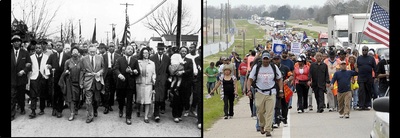
Thumbnail image for Selma to Montgomery march - yesterday and today.jpg


Private Dino Paparelli.jpgSurprising as it may be to Italian-American youth of today, with a Cuomo as governor of New York and a Scalia and an Alito as Supreme Court justices, this kid of 1950s’ Detroit hated his Italian name and resented his father for having conferred it.  “Angelo Alfredo Paparelli” was too much ethnicity to bear. 

I’m not named “Angelo” because of my father’s fondness for heavenly creatures, nor was I given the middle moniker “Alfredo” for his love of a certain pasta sauce.  Under the Italian naming tradition of primogenitore, my name was predestined.  The first-born male would take the first name of the paternal grandfather as the newborn’s first name, and the first name of the father as his middle name; and that was that.

I hated my name, not for any dislike of Italy, but because I yearned to be accepted as an American, just like the Nelsons and Cleavers on TV. My supposed TV role model, alas, was Private Dino Paparelli of the depressingly-titled You’ll Never Get Rich series (later known as The Phil Silvers Show), with the dim-witted Dino as one member of a crew of conniving Army motor-pool conscripts who regularly hoodwinked their WASPish officers.

Cass Tech.jpgI remember precisely when my name went from personal abhorrence to appreciation. The scene:  Cass Tech High School, near Downtown Detroit, during auditions for The Solid Gold Cadillac.  When the director called my name to audition, a beautiful blonde senior named Barbara exclaimed: “Angelo Paparelli! What a wonderful name!”   

I didn’t get the part, but I had a more valuable epiphany.  My name could be Ishkabibble or Geronimo — it didn’t matter.  I was just as American as former Michigan Governor G. Mennen Williams, who had a house in Grosse Pointe, and the Boyd and Williams families of Black Americans in my neighborhood; no more or less American than the Poles of Hamtramck, the Mexicans who lived near Briggs (now Tiger) Stadium, the Jews of Oak Park, the Arabs of Dearborn, or the lesbians who frequented the bar around the corner. This epiphany probably had something, at least subliminally, to do with my becoming an immigration lawyer. 

Once ensconced in my chosen vocation, I learned, however, that immigration law is not ecumenical. I discovered that until 1952, non-whites could never become citizens (although native-born Blacks were Americans from day one under the 14th Amendment’s birthright citizenship clause). As my colleague Prof. Kevin R. Johnson notes in “THE ‘NEW’ CIVIL RIGHTS: IS THE ‘NEW’ BIRMINGHAM THE SAME AS THE ‘OLD’ BIRMINGHAM?,” a paper he’ll discuss with me at a Chapman University Sociology conference next week:

During the post-Civil War period, the largest groups of immigrants affected by the whiteness prerequisite for citizenship came from Asia. Asian immigrants perpetually were denied the opportunity to naturalize and become U.S. citizens (and thus were perpetually disenfranchised from the political process). [FN]

[FN] See, e.g., Ozawa v. United States, 260 U.S. 178, 190 (1922) (finding that Japanese immigrant was not eligible for naturalization); United States v. Thind, 261 U.S. 204 (1923) (same for immigrant from India).

Indeed, it was not until 1965 that the National Origins Formula, which effectively barred Asians from immigrating, was abolished with the passage of the Hart-Celler Act

Over the years, I’ve seen the immigration color and national-origin barriers resurface repeatedly.  If you’re a Cuban and arrive at Florida’s shores, we release you to family, let you stay and give you a green card under the Cuban Adjustment Act; not so, if you’re a Haitian. 

In the late 1980s, if you sought an L-1B work visa from the UK or France to work for a car company, you were in like a swoosh; but if you hailed from Japan and were destined for a job in the auto industry, the U.S. Consulate in Osaka persuaded INS that an extralegal moratorium on L-1B issuance was necessary.

Today, if you were born in Mexico, China or India, you face decades of waiting for your date with immigration destiny — your green card priority date.  Although this may change with enactment of a bill enjoying bipartisan support — The Fairness for High Skilled Immigrants Act — nothing will happen to eliminate this disparate treatment by place of birth until a certain senator from the Cornhusker State lifts his hold on the legislation. And Osaka Redux: The U.S. consular posts in India and the latter-day INS, USCIS, now have been unmasked as inexplicably denying a much larger percentage of L-1B visas and petitions for Indian citizens, while those from Europe sail through.

Even though Congress remains in suspended animation until November’s elections, immediate corrections are nevertheless possible. The Obama Administration can help eliminate these unlawful barriers.  A simple but emphatic executive order would do the trick. 

The President should declare that — unless affirmatively mandated by law — the federal immigration agencies shall:

  • Judge people seeking immigration benefits or relief from removal as individuals, based on the merit or demerit of their factual and legal circumstances.
  • Refrain from profiling people by color or national origin.
  • Apply neutrally phrased legislation even-handedly, without regard to any personal agenda of the adjudicator to serve as an unappointed line of defense against an influx of applicants from a particular country or with a certain complexion.

The President’s order should require the Secretaries of State, Labor, Justice and DHS to produce a formal plan in 90 days to investigate and eliminate racial and national-origin profiling, discipline or dismiss any immigration officials who are found to have engaged in prohibited profiling, and publish periodic progress reports.  Under the order, claims of racial or national-origin profiling should be jointly investigated and violations enforced by the DHS Office of Civil Rights and Civil Liberties and the Justice department’s Civil Rights Division. 

As I write this blog, urging one more measure to make America a truly welcoming country, I sense my father is smiling from the grave.  He (very likely) and I (absolutely) are chuckling as we recall Mark Twain’s wisdom:

When I was a boy of fourteen, my father was so ignorant I could hardly stand to have the old man around. But when I got to be twenty-one, I was astonished at how much the old man had learned in seven years.

By the way, for those of you who’ve met me and are wondering why I have Americanized the pronunciation of my name, sounding out the letter “a” like the “BAA” of bleating sheep, just ask Antonio Mendoza in this classic Saturday Night Live sketch:

[Blogger’s note: This article is reprinted with permission from the February 22, 2012 edition of The New York Law Journal.  ©2010 ALM Properties Inc. All rights reserved. Further duplication without permission is prohibited. The authors thank the Journal for permission to reprint this article.]  

Waiting.jpg

No More Waiting on Legal Immigration

By Angelo A. Paparelli and Ted J. Chiappari 

President Barack Obama has professed a new strategy of impatience. With the economy still in malaise, and the unemployment outlook only a tad improved, the White House has begun to implement a reelection gambit entitled, “We Can’t Wait.” The waiting is not for Godot, but rather for a moribund Congress to pass his largely ignored proposal, the American Jobs Act:

Without a doubt, the most urgent challenge that we face right now is getting our economy to grow faster and to create more jobs…. we can’t wait for an increasingly dysfunctional Congress to do its job. Where they won’t act, I will.

—President Obama, October 24, 2011.

In an effort to jumpstart the economy, the approach taps his exclusive authority over federal departments to craft executive orders. Hoping to avoid the fate of Jimmy Carter, a one-term Democrat who also faced malaise, Mr. Obama’s first foray into economy-goosing executive orders has involved housing, education and veterans’ affairs. His more recent jobs-focused directives have begun (albeit too timidly and slowly in the authors’ view) to address administrative reforms to America’s system of legal immigration.

 As this article will show, an assertive President Obama, with his eyes transfixed on the reelection prize, can do much more to improve our immigration regulations and agency practices, which the President oversees through the Departments of Homeland Security, State, Justice and Labor. With presidential orders on legal immigration, he can recharge the economy in countless ways while protecting American jobs and creating hundreds of thousands of new ones.

Continue Reading

childish fantasy.jpgI’m taking a short vacation — which means that it’s time to dive into another Haruki Murakami novel. My first encounter with Murakami, a Japanese author of some 13 books of fiction, involved his immersive fantasy, Kafka on the ShoreThis time its his latest tome, 1Q84, a 925-page behemoth. 

Both books are phantasmagorical journeys through parallel universes — a fitting description of America’s unique form of unreality, its extreme ambivalence toward immigration. Unlike insular and homogeneous Japan, the locus of 1Q84, where immigration is severely restricted, the U.S. imagines itself as welcoming.  We pride ourselves on our diversity and tolerance, our freedoms of thought, religion, press and assembly, and our American Dream mythology.  Yet all around us we see behaviors and attitudes toward immigration — even in the same individuals — that are inconsistent and contrary to type. 

I first witnessed this phenomenon at a bar liaison committee meeting with Immigration and Naturalization Service (INS) officials in Los Angeles shortly after enactment of the Reagan-era legalization program, a key provision in the Immigration Reform and Control Act of 1986 (IRCA). To qualify for legalization, a nonimmigrant entrant’s unlawful status must have been “known to the government.”  INS officials wanted the pool of eligibles kept small; the immigration lawyers wanted it as large as possible.  Attitude reversals manifested immediately.  What — before IRCA — the INS would view as major transgressions of the immigration laws, say, working without permission, these same officers now saw as “no harm, no foul” occurrences unless an unauthorized foreign worker wrote a letter confessing the violation that actually found its way into the individual’s INS file.  Conversely, the immigration lawyers latched upon what we’d previously viewed as peccadilloes — failing to file a change of address report — as serious misdemeanors. 

Consider also these recent examples:

Murakami speaks to this phenomenon in 1Q84 when he has the Leader, who heads a violent cult, say:

Most people are not looking for provable truths. . . . [T]ruth is often accompanied by intense pain, and almost no one is looking for painful truths.  What people need is beautiful, comforting stories that make them feel as if their lives have meaning.

back_light_silhouette_of_man_holding_globe.jpgImmigrants are not memes; nor are the painful truths about immigration.  Yes, despite the flaws in a recent governmental investigation, immigration fraud does exist — though probably not even close to the degree that the Inspector General for Homeland Security suggests.  Yes, many immigration and consular officers may operate on hidden agendas of Machiavellian proportions and deny cases unjustly, but others truly care that they make correct decisions based on law and fact.  Yes, immigrants bring energy, entrepreneurship, innovation and wealth to America, but some of our citizens — particularly at the low end of the skills range — may be displaced (and thus need extra help).

We as a people and a polity will not eradicate every scintilla of possible harm from immigration nor enjoy solely its benefits.  We must face the immigration truths, however painful, and eliminate as many dysfunctions as bright minds and compassionate hearts can achieve.   What we cannot do is continue to believe in “beautiful, comforting stories that make [us] feel as if [our] lives have meaning” but at bottom are palliative falsehoods.


Thumbnail image for young soldiers.jpg[Blogger’s note:  This week’s guest blog is by Steve Yale-Loehr, a good friend who teaches immigration law at Cornell Law School and co-authors the leading U.S. immigration treatise. Steve has just finished co-editing Green Card Stories, a book that features dramatic narratives of 50 recent U.S. immigrants—each with permanent residence or citizenship—in compelling essays by nationally recognized journalist Saundra Amrhein and exquisite portraits by award-winning documentary photographer Ariana Lindquist.

Steve addresses pragmatic, legal and moral questions raised by GOP proposals that would drop the option of pursuing higher education and instead require DREAM Act youth to serve in the military as the only way to attain legal status. 

Reading Steve’s post, I am reminded of the despicable term, “cannon fodder,” and the hypocrisy of sending “expendable” youth into harm’s way, where many lives will likely be cut short, wasted in wars started by their elders.

Shakespeare penned it best when he had the cynical Falstaff say in Henry IV, Part I:  Food for powder, food for powder; they’ll fill a pit, as well as better.”

A military-only DREAM Act — more aptly dubbed the NIGHTMARE Act — sends a terrible message.  Congress should keep the education-option available to innocent men and women (brought here by their families) who by any definition — other than in law — are Americans all.

Blogger’s postscript to his note: I must apologize for having used the term “cannon fodder” and suggesting that some might view soldiers recruited through a military-only version of the DREAM Act as “expendable.”  I now understand and regret that reasonable readers might view this as a criticism of the U.S. military. My intent was to criticize politicians not our armed services.]

DREAM or NIGHTMARE?: 

Why Congress Should Reject a Military-Only Version of the DREAM Act

By Steve Yale-Loehr

First proposed in 2001 by Senators Orrin Hatch (R-UT) and Richard Durbin (D-IL), the Development, Relief and Education for Alien Minors (DREAM) Act would allow certain undocumented noncitizens a chance to legalize their status by going to college or serving in the military. Since then it has been introduced regularly both as a stand-alone bill and as part of comprehensive immigration reform bills, drawing bipartisan support each time in both the House and Senate. The closest it has come to enactment was in 2010, when it passed the House but failed to get through the Senate.

Congress has watered down the DREAM Act over the last decade.The original 2001 version would have granted permanent resident status (green cards) to any undocumented child who had been in the United States for at least five years, as long as they had good moral character and were attending a college or university.

By contrast, the Senate’s 2011 version of the bill would require individuals to have entered the United States before they were 15; have graduated from a U.S. high school or received a GED from a U.S. institution;be under 35 on the date of enactment; and have lived in the United States for at least five years. Prior versions of the bill did not include an age cap. Similarly, the current version of the bill would require beneficiaries to stay in conditional resident status for six years before they could get permanent green cards. Early versions of the DREAM Act would have immediately granted green cards to individuals who met the bill’s requirements.

The current version would also make applicants subject to more grounds of inadmissibility, deportability, and other restrictions. Some want to water down the DREAM Act even more.Republican presidential candidates Mitt Romney and Newt Gingrich say they would support a DREAM Act — but only for young immigrants who join the military. Representative David Rivera (R-FL) has introduced a bill along similar lines.

Problems with a military-only DREAM Act range from the practical to the philosophical. For example, Representative Rivera’s bill would require people to enlist within nine months; otherwise they would lose their eligibility under the bill. The bill fails to realize, however, that people can’t start the enlistment process until they are legal and have a social security number. It can take longer than nine months to complete the enlistment process, and the military services have annual quotas that get filled quickly when the economy is bad, forcing people into the next fiscal year.

In addition, some potential enlistees may fail to qualify for medical reasons. Suppose someone gets temporary status under the Rivera bill, tries to enlist, and turns out to be colorblind. Do we tell them, “Sorry, we are deporting you because you are colorblind. No refund of the immigration fees you paid to start the DREAM Act process”?

The call for a military-only DREAM Act also poses moral problems. It effectively tells undocumented noncitizens that they are only useful for war, not for improving our economy through their hard work or inspiring the next generation by teaching in our schools. Those professions are just as noble as fighting for our country. As a new book, Green Card Stories, points out, people who legalize their status help this country in a variety of important ways.

Proponents of a military-only DREAM Act also forget the economic benefits of enacting a broader bill. For example, A 2010 study by the UCLA North American Integration and Development Center estimates that the total earnings of DREAM Act beneficiaries over the course of their working lives would be between $1.4 trillion and $3.6 trillion. Similarly, a 2008 study from Arizona State University found that an individual with a bachelor’s degree earns approximately $750,000 more over the course of his or her lifetime than an individual with only a high-school diploma. In these tough economic times, we need the earnings of everyone in this country as much as we need their military service.

Langston Hughes once wrote:

What happens to a dream deferred?

Does it dry up like a raisin in the sun? 


Or fester like a sore and then run?

Does it stink like rotten meat?

Or crust and sugar over, like a syrupy sweet?

Maybe it just sags like a heavy load.

Or does it explode?”

Politicians should watch out. Trying to dilute the DREAM Act may backfire on them and cause DREAMers to explode in widespread demonstrations and cries of outrage, if necessary to enact a true DREAM Act.

“Damn with faint praise, assent with civil leer And, without sneering, teach the rest to sneer” ~ Alexander Pope, poet, satirist, and translator, “Epistle to Dr Arbuthnot

clock face time 3.jpgI hesitate to criticize the Obama Administration’s immigration reform measures, having urged long ago that half a loaf, at least for now, will perforce suffice

Hastily announced but untimely in manifestation, the slew of executive half-measures the President’s team has lately proposed to improve the functioning of America’s broken immigration system seem reminiscent more of vaporware than tangible solutions. 

With less than a year to go on his term, executive orders and departmental or agency press releases are spewing forth as if from a Gatling gun

Will these concepts really make a difference?  Or are they merely pheromones to attract progressive, young or Hispanic voters in November?

Consider how much has been said but so little done:

  • Prosecutorial Discretion is announced as a measure to spare low-level immigration violators and slam dangerous foreign felons.  So far the record deportations continue almost unabated and the few granted PD are permitted to remain at the pleasure of the President but without deferred action and its benefit of work permission.
  • Stateside waiver processing for immediate relatives of U.S. citizens whose hardship can be proven as extreme is revealed in a seemingly humanitarian Notice of Intent and an FAQ.  But no rules or procedures have yet been published, and the risk of death-by-visa-waiting remains as high as ever.
  • An interdepartmental push to improve visa processing and promote tourism is inscribed in an Executive Order, with special focus on increased consular officers in Brazil and China.  Still, nothing is said about tourists and business visitors from India whose rupees are as easily converted to dollars and spent in our malls.  Worse yet, no reforms are made by the State Department that would moderate consular absolutism and encourage visa officers — by amendment of the Foreign Affairs Manual — to extend a welcome mat more often to foreign visitors with lucre to spend.
  • A DHS grab bag of small measures are announced with the goal “to retain highly skilled workers.” These ethereal proposals will likely affect only a tiny slice of the job-creating nonimmigrant population. The list of unrealized hopes includes a nebulous assemblage of H-4 dependents married to H-1B workers “who have begun the process of seeking lawful permanent resident status through employment after meeting a minimum period of H-1B status in the U.S.”  It also makes note of the leisurely first convening on February 22 of an “Information Summit [at an undisclosed location] in Silicon Valley, CA [where is that? I can’t find the city on my California map], that will bring together high-level representatives from the entrepreneurial community, academia, and federal government agencies [first announced on August 2 of last year as step one of the Entrepreneurs in Residence program] to discuss how to maximize current immigration laws’ potential to attract foreign entrepreneurial talent.”

Desultory blather and high-falutin’ promises will not jumpstart job creation. Deeds not words — published forms, specific eligibility criteria and actual procedures to request new benefits — are what real administrative reforms require.   

biohazard time.jpgThere are many bold steps that could be taken to improve our dysfunctional system even while Congress remains comatose.  Gary Endelman and Cyrus Mehta suggest a Presidential tweak in the interpretation of green-card counting procedures that would eliminate backlogs and do far more than merely granting spousal work permission “to retain highly skilled workers” (“Why We Can’t Wait: How President Obama Can Erase Immigrant Visa Backlogs with the Stroke of A Pen“).  Other proposals have been offered in this blog (“Executive Craftsmanship: Job Creation through Existing Immigration Laws,” “The Immigration Appeaser-in-Chief Should Try Some New Ammunition” and “Immigration Reform with the Stroke of a Pen“).

When it comes to executive action on immigration, the nation needs a profile in courage not a silhouette of timidity.  The first Tuesday in November is fast approaching.  Time waits for no President.

grand canyon.jpgEver since I first sat in a Los Angeles movie theatre watching Grand Canyon, Lawrence Kasdan’s 1991 film, the only movie, to my knowledge, whose protagonist is an immigration lawyer, I knew I would mouth to myself, repeatedly over the ensuing years, one of its memorable lines.  The main character, Mac (played by Kevin Kline), practices a rather pathetic and half-hearted version of deportation defense in the City of Angels. Consumed by existential angst and a career going nowhere, Mac sits in his law office and screams to his secretary and to himself:  “I hate [bleep]ing immigration law!

Don’t get me wrong, after 30+ years as an immigration lawyer, I remain passionate about immigration and fulfilled in my career, mostly far closer to Emma Lazarus than to Mac. When the day’s mail arrives, my heart still goes aflutter as official government envelopes are opened to reveal approval notices  — proxies for one client’s or another’s American Dream about to take wing. 

This enjoyable ritual, alas, is increasingly disrupted by jarring correspondence from U.S. Citizenship and Immigration Services (USCIS) — the dreaded Request for Additional Evidence (RFE). To be sure, a righteous RFE — and some assuredly are — is a good thing, offering a second chance to clarify what may have been less than clear in the initial submission. 

A roguish, stupid or intellectually dishonest RFE, however, will cause me to erupt into silent, internal conniptions (I can’t actually shout expletives in my law firm because that would likely create a hostile workplace and trigger multiple unpleasantries under state and federal law). Living in California, the land of holistic therapies, I know that anger swallowed often morphs into depression.  To avoid that dreadful fate, I pen this post as a way to release outrage, stay healthy, and light a candle on RFE avoidance and response.

  1. Know the law and the non-law. While any immigration lawyer worth her salt understands the legal requirements to establish eligibility for the requested visa benefit, and knows how to muster supporting evidence, the RFE avoidant practitioner must also be familiar with the latest patterns among USCIS adjudicators in asking for legally irrelevant evidence. For example, no matter that the L-1 (intracompany transferee) visa is not one requiring a cash investment in a U.S. entity or a purchase of stock, expect that an adjudicator will request proof of funds transferred from abroad to buy a controlling interest in the petitioning business.  Similarly, although the working owner of a U.S. limited liability company seeking an H-1B (specialty occupation) visa to run the business would almost never appoint a board of directors (since the LLC envisions flexible and speedy management decisions), make sure that your client goes to the expense and burden of appointing a board so that an “employer-employee” relationship of owner to LLC can be proven.  Unfortunately, there is no treatise or hornbook that can help the hapless lawyer find out trends in RFE demands because these documents, though templated, change appearance as readily as chameleons. The only way to discern RFE trends (other than receiving them in bulk) is to network and share notes with other immigration lawyers.
  2. Manage client expectations.  RFEs, if unanticipated, often can destroy relationships with existing and new clients.  Good immigration lawyers inform the client of the possibility at the start of each engagement and each matter that USCIS will issue an RFE .  The lawyer’s scripted conversation with the client goes like this (with quote in italics): “There is a possibility — no matter how well we prepare our filing — that USCIS will ask for more evidence.  You, client, have a business decision to make, and within reason, I will abide by your instructions.  Either, we anticipate every imaginable item of evidence (based on evolving patterns of RFE requests) and adopt a kitchen-sink strategy in submitting our proof, which is the strategy I recommend, or, you can authorize me to request of you and submit to USCIS only the types of evidence reasonably necessary to establish legal eligibility for the immigration benefit you seek.  We may or may not receive an RFE under either strategy.  The government (acting godlike, but without the grace) behaves in mysterious ways.  Your best chance of avoiding an RFE is by presenting as much evidence as possible.”  
  3. Make it easy for the adjudicator to “Get to Yes.” Having gathered all possible evidence, the attorney should provide proofs in a logical and organized way.  The attorney’s covering letter (which the officer may or may not read) should be a roadmap to eligibility.  It should refer to an index of clearly-tabbed and logically-organized documents, refer to facts evidenced in the record or attested to by the client, describe in summary form what each item of evidence purports to establish and why each is relevant.  The attorney’s letter should also cite the law, regulation, policy memorandum, guidance letter, legislative history, adjudicator’s field manual, bar association liaison minutes or other source of legal authority that establishes eligibility under the proven facts.  Here is a simple rule for staying out of legal trouble and RFE hell:  Clients and third parties attest to the facts; lawyers refer to the facts elsewhere established in the submission, describe why each factoid of proof is relevant under law, and demonstrate why “yes” is the legally proper answer.
  4. Use word-pictures, graphics, charts and hyperlinks. Boring, sloppy, careless or poorly proofed writing pains and perturbs the reader.  Vivid, logical, grammatically correct, stylish and persuasive writing pleases the reader.  Text alone, however eloquently presented, may fail to make the desired impact.  Eligibility under law is often more readily established if graphical images and links to web-based materials support the messaging of the text-based submission.  The most likely way to enliven interest and avoid an RFE is to awaken an otherwise indifferent adjudicator, and provide compelling overt and subliminal reasons to approve the case.
  5. Humanize the case through honest storytelling. Contrary to some immigration lawyers’ perceptions, adjudicators are human.  While examiners may be more focused on behaviors that reward them personally such as reporting suspected fraud, way down deep, they may just be moved to identify with the human condition.  If the adjudicator can be encouraged to see your client as a deserving human being, rather than just another file to be acted on before the end of the work day, maybe an RFE will not be sent, but an approval notice instead.  Talk in the submission about the consequences of a “yes” or “no” decision to your client and to the country –whether that client is a company, a person, a family, a university or a religious community.  Even adjudicators prefer to hold up their heads by doing the right and good thing rather than just adding another notch on their life-destroying revolver.
  6. Garner a reputation for zealous representation under law.  Pushovers get pushed over. If an adjudicator knows you as a lawyer who will stand up for your client and wield the tools of the law skillfully to achieve a just outcome, there is less of a likelihood that a thoughtless or unjust RFE will come your way.  Don’t just give up, if the RFE or a denial is issued.  Press on.

Notwithstanding your scrupulous adherence to the Boy Scout Code (Be Prepared), the postal worker may nonetheless deliver an RFE.  After the inevitable silent cursing is over, the immigration practitioner and clients will pursue a course of action that may exhibit one or more of the following stratagems:

  1. Resist the temptation to respond sarcastically. Displays of temper or efforts at ridicule in response to RFEs meet with success as rarely as similar behaviors prevail with TSA officers. 
  2. Distinguish boilerplate from customized text. Every RFE contains a mix of both.  Consider the template text carefully (perhaps there’s a grain of significance there), but focus on the specially drafted text that will likely reveal how carefully the adjudicator considered the evidence presented in the case.  If the tailored portion of the RFE mischaracterized the factual record or failed to notice key evidence already presented, then plan on diplomatically noting these missteps in the response. 
  3. Note whether the RFE contains assertions about legal requirements.  If such claims are unsupported by citation to legal authority and misstate the law, then quote Kazarian v. U.S. Citizenship and Immigration Services, a 9th Circuit case which in essence rebukes USCIS for making stuff up.  If the assertion differs from existing USCIS policy, point out the difference and cite Judulang v. Holder, a unanimous Supreme Court case which declined to follow an immigration agency’s position because the agency (in that case, the Board of Immigration Appeals) “has repeatedly vacillated in its method for applying” the law’s requirements.
  4. Respond fully with fresh evidence.  While re-arguing the significance of evidence originally submitted but treated as insufficient may occasionally succeed, the better approach is to rebut the interim conclusions suggested in the RFE with relevant and responsive evidence.  The evidence may involve proof of company or industry practices, scientific accomplishments or contributions to the economic or other national interests of the United States.  Whatever the issue of concern, take a fresh look at the best way to proffer the rebuttal evidence.  Perhaps it should come from one or more outside experts of unquestioned accomplishment and repute, a forgotten immigration policy memo or guidance letter, the dusty legislative history of a law long ago enacted, the supplemental information in a proposed or final regulation, or a government agency outside the immigration world.  Whatever the source, protect the administrative record with compelling evidence.
  5. Enlist government support or generate media scrutiny where appropriate. Sometimes RFEs are so off base that — in addition to responding fully — the practitioner may wish to enlist others in government with relevant authority.  Perhaps the USCIS Ombudsman, a Headquarters official or a member of Congress may be interested in learning of and resolving anomalies in service delivery or clearly wayward RFEs. Alternatively, if the client is willing, your resort to media focus (either traditional journalists or others proficient in social media) may be justified.  These unusual approaches may be premature (for an approval notice may yet be forthcoming) or better pursued if a denial is issued. 

Sometimes, the distance between an RFE and an approval notice are as wide as the Grand Canyon.  Thus, immigration stakeholders (in the words of a Washington Post review of the eponymously titled film) should “consider the ever-widening chasms that divide us, [and] the shifting demographic fault lines that have set society quaking like the needle on Richter’s scale.”  By employing the suggestions in this blog post, however, perhaps the distance will shrink and our clients’ American Dreams will yet be fulfilled.

immigration justice with lawyers.JPG

Many thoughts rushed through my mind as I read the heartening headline to a press release issued January 19 by the American Immigration Council (“U.S. Citizenship and Immigration Services Takes Steps to Improve Noncitizens’ Access to Legal Counsel“). 

What did USCIS do to improve access to lawyers?  Did it instruct the agency’s Fraud Detection and National Security Directorate that no site visits could be conducted without prior notice to the parties’ attorneys of record?  Did it decide that FDNS could not interrogate employers and foreign workers unless their counsel were present?  Did the agency instruct USCIS personnel stationed abroad at American embassies and consulates that lawyers must be allowed to accompany clients into the interrogation rooms?

Swept up by curiosity, I skipped the press release and clicked on the hyperlink to the USCIS interim policy guidance pronouncing in red ink: “This memo is in effect until further notice.” As I read through the guidance, disappointment set in and two thoughts entered my mind: 

  1. The American Immigration Council (AIC) must have come down with a mild case of Stockholm Syndrome.  Apparently the Council had become so captivated by USCIS that this highly regarded nonprofit seems to have mistaken “a lack of abuse . . .  for an act of kindness.”
  2. USCIS has assumed the role of Senator Daniel Inouye during the Iran-Contra hearings when attorney Brendan Sullivan famously replied to the senator’s complaints about the lawyer’s interjections,  “Well, sir, I’m not a potted plant. I’m here as the lawyer. That’s my job.” 

The AIC’s misleading headline notwithstanding, the “new” USCIS policy guidance does not really break new ground in its dealings with lawyers.  While the policy — to be sure — quite laudably clarifies and limits the roles of non-lawyer representatives and attorneys admitted in foreign countries, and makes sure that notices are sent to both the attorney and the client, the interim guidance fails to “improve” clients’ access to members of the bar licensed in any of the 50 states. Indeed, in some respects, it makes matters worse.

The prior policy, reflected in the Adjudicators Field Manual (AFM), provided: 

Chapter 12 Attorneys and Other Representatives.

12.1     [Reserved]
12.2     [Reserved]
12.3     [Reserved]
12.4     [Reserved]
12.5     [Reserved] . . .

15.8 Role of Attorney or Representative in the Interview Process. Frequently an attorney will be present to represent a subject. The following rules should be followed when the person being interviewed is accompanied by legal counsel: 

  • Interviewing officers should verify that a properly executed Notice of Entry of Appearance as Attorney or Representative (Form G-28) is part of the record.
  • The attorney’s role at an interview is to ensure that the subject’s legal rights are protected. An attorney may advise his client(s) on points of law but he/she cannot respond to questions the interviewing officer has directed to the subject. . . .
  • Officers should not engage in personal conversations with attorneys during the course of an interview. (Bolding added.)

The interim policy guidance substituted the foregoing with this new instruction:

The role of the representative at an interview is to ensure that the rights of the individuals he or she represents are protected. . . .

Any individual appearing in a representative capacity may not respond to questions the interviewing officer has directed to the applicant, petitioner, or witness, except to ask clarifying questions.

Officers should not engage in personal conversations or arguments with attorneys or other representatives during the course of an interview.

An applicant or the applicant’s attorney or representative should be permitted to present documents or other evidence that may help to clarify an issue of concern to the interviewer. When possible, such evidence should be submitted and reviewed before the interview, and when relevant, should be added to the applicant’s file. . . .

The attorney or representative may raise an objection on an inappropriate line of questioning and, as a last resort, may request supervisory review without terminating the interview. . . .(Bolding added.)

gagged lawyers.jpgNote that under the former AFM provision a lawyer “may advise his client(s) on points of law”. 

This express statement of the lawyer’s role is inexplicably omitted from the new guidance.  Now a lawyer may merely present written evidence,”ask clarifying questions,” and “raise an objection on an inappropriate line of questioning.”  

The new guidance, in my view, offers a powdered-wig view of law and improperly circumscribes the conduct of lawyers.  Fortunately, however, the real-world interactions between USCIS examiners and immigration attorneys have not been quite so constrained.  Experienced examiners know that a lawyer can help lead to a just outcome in many an immigration case, for example:

  • when helping to explain why a complex corporate structure involving multiple tiers of entities overseas and in the U.S. qualifies for EB1-3 Multinational Executive or Manager immigrant visa classification;
  • when showing in a family-based immigration case that a divorce would be recognized under foreign law such as (heaven-forbid) Sharia law;
  • when demonstrating that an EB-5 immigrant investor satisfies the requirement that he or she be engaged in the direct management of the enterprise merely by serving in the role of limited partner under 8 CFR § 204.6(j)(5)(iii).

The new USCIS guidance urges examiners to “remember that an adjudicator is duty-bound to develop the facts, favorable as well as unfavorable.”  I maintain that an adjudicator is equally duty-bound to apply the law to the facts, and that a lawyer should be expressly allowed under revised policy guidance to play a role in helping the examiner fulfill this duty.

The USCIS should also expand its guidance by taking into account the suggestion of the Alliance of Business Immigration Lawyers in a white paper presented to the agency:

All Interested Parties Must be Allowed a Right of Meaningful Participation in Requests for Immigration Benefits and in Administrative Appeals.

Under current law and regulations, many parties with a tangible legal interest in the outcome of an immigration-benefits request have no right to make an appearance in person or through legal counsel before USCIS.

As immigration law has evolved, legislation and regulations have increased the actual and potential conflicts of interests. As a result, situations increasingly arise where a variety of individuals and entities have distinct legal interests to protect in an immigration matter. These parties in interest can include, among others:

  • beneficiaries of an I-129 or an I-140 petition (who currently cannot get a copy of the petition to show that they were in compliance of the law, to qualify under the 245(i) grandfathering provisions, or to port to an approved Employment based petition);
  • Regional Centers in EB-5 immigrant investor petitions, which cannot enter appearances to demonstrate that their investments qualify under the initial EB-5 determination or the removal of conditions phase, even though an RFE might challenge the Regional Center’s investment or its job-creation calculation;
  • the corporate employer in the success of its foreign workers’ I-485 adjustment of status cases or the workers’ family members’ applications for extension or change of status, as the employer may be injured by loss of the employee’s services; and
  • the guardian of a child’s interest or an estranged spouse in a derivate employment-based immigration matter involving the principal applicant.

The G-28 — indeed, the USCIS’s regulations and the [Immigration and Nationality Act] — should be modified to recognize and allow separate legal representation of each of the parties with legitimate legal interests to protect. Failure to do so prevents USCIS from getting all the facts and considering all the legal issues raised in immigration matters. That USCIS’s current technology infrastructure lacks the capacity to provide notices, decisions and correspondence to multiple parties in interest and their respective attorneys is no reason to deny procedural and substantive due process.

potted plant.jpgAs a starting point toward ensuring “meaningful participation in requests for immigration benefits,” the USCIS should proclaim that lawyers are not potted plants to be carried into interview rooms by their clients. 

Rather, the agency in revised guidance should affirm that immigration lawyers, as officers of the court, with a duty of integrity and honesty in USCIS proceedings, are essential participants in assuring that the rule of law is observed and justice done whenever petitioners and applicants request immigration benefits.

praying man with baloney.jpgThe historian said to the venture capitalist, “Let’s drop the pious baloney,” as each sought the highest office in the land. No, this post is not the set-up to a joke, except perhaps a nod to the risible circular firing squad that the GOP presidential candidates have formed

And it’s not about a sliced and packaged meat sausage, more accurately termed “bologna,” a carnal creation of indeterminate provenance defined by federal law.  Nor is it about “holy baloney,” a line from Haunted Honeymoon, a long-forgotten 1986 film.

Rather, the reverential  “baloney” of which I blog is that unhealthful mixture concocted behind closed doors in legislative and administrative abattoirs, the one that comes to mind with the unverified quote attributed to Bismarck (“If you like laws and sausages, you should never watch either one being made”).

In particular, this post is about the multiple pages of sanctimonious hogwash (summarized here), served up last week by the Homeland Security Department’s Office of Inspector General (“The Effects of USCIS Adjudication Procedures and Policies on Fraud Detection by Immigration Services Officers“). This is apparently the same report as the draft version selectively excerpted for sensational effect by The Daily, critiqued last week on this blog (“Power-Mad Career Immigration Bureaucrats Cry Wolf, Spook DHS Leaders“). 

In essence, the IG reports that:

  • “Immigration law is complex, and USCIS administers benefits of great value.”
  • “Benefit fraud detection is challenging and has always created difficulties for federal agencies. . . . Threats to the immigration benefit system have not abated. In the 2012 DHS Appropriations Bill, the House of Representatives described recent attempted terrorist attacks on the United States as ‘ongoing efforts by extremists to infiltrate our country through the exploitation of legitimate travel and immigration processes.'”
  • Immigration adjudicators, now dubbed “immigration service officers” (ISOs), and immigration fraud detection officers (IOs) don’t have sufficient opportunity to exchange views and work together.  They should rub elbows more often, and ISOs need more fraud-detection training.
  • Half of the annual performance evaluation of ISOs is based on the adjudicator’s demonstrated ability to detect and report suspected immigration fraud and national-security threats (the other half is based on the quality of adjudications).  Still, pressure (whether self-imposed or from USCIS) to produce decisions in volume persists and adversely affects fraud detection and adjudication quality.
  • USCIS guidance on when to request additional evidence is confusing.
  • Some ISOs perceive that USCIS supervisors and managers interfere with or overrule their decisions or reassign cases to more approving adjudicators.
  • There must be validity to these ISO concerns because the USCIS Administrative Appeals Office (AAO) “frequently supports the ISO’s decision on appeal,” as the AAO did in a case involving a former USCIS Chief Counsel who intervened on an O-1 extraordinary-ability-alien petition submitted by the University of Arizona. 
  • The IG is concerned “with those cases where [Office of USCIS Chief Counsel (OCC)] leaders may create pressure on the adjudications process so that improper approvals are or could be made.” Thus, the IG believes that “[s]ome limitation on OCC’s ability to affect the adjudications process is necessary.”
  • The IG also worries that outside immigration lawyers may improperly influence USCIS management to pressure ISOs into approving undeserving cases or those where fraud is suspected. “ISOs and managers in some USCIS offices said that efforts to undercut some denial decisions waste USCIS resources and send an implicit message to approve petitions and eliminate outside complaints. We were informed that special treatment remains prevalent. . . . An ISO said that the American Immigration Lawyers Association ‘owns’ USCIS. USCIS is aware of this perception . . .” 
  • “USCIS has yet to find an effective balance between its interaction with the public, especially immigration attorneys, and the need to protect the integrity of the adjudications process. This is a dilemma, because many people have an interest in USCIS decisions, and public comment is vital to the regulatory process. USCIS should strive to recognize the differences between legitimate public opinions about its processes and requests to change individual case decisions. Those who gain a special review of their case essentially receive a second adjudication without having to file an appeal.”
  • The current standard of proof to establish immigration-benefits eligibility — a preponderance of the evidence — does not sufficiently achieve the DHS mission of preventing fraud. “To further protect the immigration system, Congress may wish to raise the standard of proof for some or all USCIS benefit issuance decisions. . . . A relatively low standard of proof does not account for all societal interests involved in the issuance of immigration benefits. ”  

Just like most baloney, the IG’s report is encased in a superficial shell, a shiny plastic wrap that presents its contents in the most favorable light. To understand the redolent bolognese features of the IG’s report, however, readers should first recall key components from the tool kit for spotting falsehood offered by the late Carl Sagan in “The Fine Art of Baloney Detection“:  

  • Wherever possible there must be independent confirmation of the facts
  • Encourage substantive debate on the evidence by knowledgeable proponents of all points of view.
  • Arguments from authority carry little weight.
  • Spin more than one hypothesis – don’t simply run with the first idea that caught your fancy.
  • Try not to get overly attached to a hypothesis just because it’s yours.
  • Quantify, wherever possible.

The IG report fails on all of Sagan’s points. It begins with a flawed premise, namely, that Congress (other than merely the instigator of the report, Sen. Charles Grassley) is very worried about lapses at USCIS in detecting fraud.  Rather the IG falsely premises the supposed Congressional concern about anti-fraud failings within USCIS by citing to a House report that referred solely to failures at U.S. consular posts and embassies abroad.  Here is the full quote from House Report 112-091 pp. 50-51 cited by the IG in referring to “‘ongoing efforts by extremists to infiltrate our country through the exploitation of legitimate travel and immigration processes'”:

The Committee provides $32,489,000 for the ICE Visa Security Program, an increase of $3,000,000 above the amount requested. This program places ICE investigators overseas to review visa applications from high-risk countries and populations and to uncover ties to extremist or criminal groups. Recent attempted terrorist attacks on the United States have highlighted the ongoing efforts by extremists to infiltrate our country through the exploitation of legitimate travel and immigration processes. The Committee believes that expanding the program to additional countries will reduce fraud and security risks in the issuance of visas and thereby reduce terrorist travel to the United States and international criminal activity. The Committee directs ICE to provide a classified briefing no later than November 1, 2011, on how it will utilize these additional funds to expand the program. (Bolding added.)

Clearly, the House was worried about the Underwear Bomber and other applicants abroad seeking U.S. visas, and the IG has been caught with its pants down.

The IG also erred when it extrapolated from a very small sample of USCIS employees, 147 managers and staff, and received 256 responses to an online survey.  As AILA President Eleanor Pelta has noted:

[This is a] total of 403 employees out of an 18,000 person workforce, or about 2 percent. Of that two percent, 63 individuals expressed a concern about pressure to approve cases. That is fewer than 25% of the individuals who responded to the online survey, and .03% of the total population of individuals who process applications for benefits for USCIS. I’m not a statistics expert, of course, but to my untrained eye this just doesn’t seem to be a valid sample size from which one could draw any useful conclusions whatsoever. To paraphrase something my mother might say, “From this you can make a report?”

Aside from problems with the small sample size, the survey questionnaire was drafted in a manner that made it impossible to draw meaningful conclusions.  It poses compound questions that conflate legal ineligibility for an immigration benefit with concerns over suspected fraud:

Have you personally ever been asked by management or a supervisor to ignore established policy or pressured to approve applications for benefits that should have been denied based on the Adjudicator Field Manual, other USCIS policy documents, or fraud/ineligibility concerns? (Bolding added.)

The IG readily acknowledged that inferences drawn from its findings may be unjustified:

[The] testimonial evidence that our interviewees provided may not be views shared by other employees. Quotations from our interviews and survey responses reflect the views and personal experiences of individuals, not necessarily the experience of most ISOs across the United States. . . . General employee concerns about the impact of production pressure on the quality of an ISO’s decisions do not mean that systemic problems compromise the ability of USCIS to detect fraud and security threats. No ISOs presented us with cases where benefits were granted to those who pose terrorist or national security threats to the United States.

Although the IG report was limited to internal sources, investigators apparently did not interview anyone at the USCIS Office of the Ombudsman, the DHS unit “created by Congress in the Homeland Security Act of 2002 to help individuals and employers who need to resolve a problem with [USCIS] and to make recommendations to fix systemic problems and improve the quality of services provided by USCIS (although the IG snagged data from various Ombudsman’s reports).

Also absent from the IG report is any recognition that the benefits made available by Congress  to eligible petitioners and applicants under the legal immigration system provide innumerable opportunities of tremendous value to America. The IG also seems oblivious to the harm that an adjudication system rewarded by a 50% focus on fraud will cause, having forgotten the wisdom of Abraham Maslow (“If the only tool you have is a hammer, you tend to see every problem as a nail.”)

In addition, the IG assumes without investigation or evidence that ISOs know the immigration law (even though few are lawyers), that the AAO knows the immigration law (even though not all are lawyers), that the training provided to ISOs on substantive immigration law is adequate, or that outside lawyers and other stakeholders who bring problems to the attention of USCIS management are improperly pressuring ISOs to reverse their decisions.  It may be that these efforts are nothing more than quality assurance opportunities, or teachable moments

To its credit, the leadership at USCIS challenged the IG report on several grounds.  The most significant challenge goes to the heart of the IG’s ill-conceived concern about perceived pressure on ISOs:

The manner in which USCIS handles or addresses a stakeholder inquiry or complaint depends on the nature and complexity of the incoming information. Some inquiries are very straightforward and can be addressed quickly with readily available information. However, other inquiries or complaints are more complex and may involve allegations of case mishandling, inconsistency in USCIS decisions, or violations of privacy and civil rights or civil liberties. In such instances, USCIS’s review of the incoming information could lead to a substantive review of any decision associated with the allegation. While the adjudicator involved may subjectively perceive a request to review a decision as putting undue pressure to ensure a certain outcome, such is not the intention of the request. Rather, USCIS’s responsibility is to ensure that the decision was correct and that the allegations are addressed. . . . USCIS does not perceive any pervasive or systemic problem along the lines implied . . . (Bolding added.)

Surprisingly, however, the IG does not address the very specific areas of Sen. Grassley’s concern when commissioning the report:

Please specifically review whether the leadership changes and internal managerial rotations made at the California Service Center in July/August 2010 led to pressure to approve more cases. Please review communication between Service Center Operations leadership and California Service Center leadership to determine if there was support, or lack of support, for addressing fraud and what, if anything, changed in July/August 2010.

While the IG report does review the action of the former USCIS Chief Counsel, without naming Roxana Bacon, it merely presumes, as noted, that she must have been wrong because the AAO affirmed the adjudicator in the University of Arizona O-1 case.  Roxie Bacon, however, offered me a very different and revealing analysis of that matter:

The CSC [California Service Center] which had run autonomously for so long was especially alarmed with efforts to formulate and adopt centralized standards and true accountability/transparency for the adjudications. Nowhere are guidelines and adjudicatory tools more needed than in the complex, difficult and subjective review of “O” petitions. The leadership at CSC threw up every type of defense to do things as they chose. . . . The U of A case, the inquiry of which came from DHS’ central office staff, was a great example of the perils of having non-experts try to assess a case that had so many elements needing a good tool kit. And of course as we know a spirited disagreement about what the tools could and should be is healthy . . . 

Roxie’s assessment, notwithstanding the AAO’s apparent affirmance of the O-1 denial, is supported by a federal appellate court ruling, not cited by the IG, which rebuked both the AAO and the California Service Center in ruling on the proper standards of determining eligibility in a case involving the EB1-1 extraordinary-ability immigrant-visa analogue to the O-1 category. The Ninth Circuit Court of Appeals in Kazarian v. U.S. Citizenship and Immigration Services, Case No. 07-56774, filed September 4, 2009, amended March 4, 2010, recently determined that the CSC and the AAO “may not unilaterally impose a novel evidentiary requirement” without support in the Immigration and Nationality Act or agency regulations, citing Love Korean Church v. Chertoff, 549 F.3d 749, 758 (9th Cir. 2008). Love Korean Church (at footnote 7) extended this principle to requests for evidence:

It is of course true that “[i]n appropriate cases, [USCIS] may request appropriate additional evidence relating to [the statutory] eligibility . . . of the [petitioning] organization, the alien, or the affiliated organization.” 8 C.F.R. § 204.5(m)(3)(iv). This provision, however, does not authorize [USCIS] to impose, as it did here, additional threshold requirements that are “plainly erroneous or inconsistent with the regulation[s].” Bassiri [v. Xerox Corp.], 463 F.3d [927, 930] (9th Cir. 2006) (internal quotation marks and citation omitted).”

If the IG really wants to be fully responsive to Sen. Grassley and can the baloney, it should reopen its investigation, conduct a statistically valid review, and solicit the observations of external stakeholders, for as Carl Sagan observed:

Finding the occasional straw of truth awash in a great ocean of confusion and bamboozle requires intelligence, vigilance, dedication and courage. But if we don’t practice these tough habits of thought, we cannot hope to solve the truly serious problems that face us — and we risk becoming a nation of suckers, up for grabs by the next charlatan who comes along.

We are a Nation of Immigrators, not a nation of suckers.

Thumbnail image for wolf_howling_rear.jpgImmigration stakeholders howled with joy this week over an announcement by Janet Napolitano, the Secretary of Homeland Security (DHS), and the DHS agency, U.S. Citizenship and Immigration Services (USCIS), about the forthcoming publication of a new immigration regulation.

Usually, the intention to publish a rule is no cause for huzzahs.  But this Notice of Intent is different.  It presages a rule that would prevent the separation of families for up to ten years by allowing unlawfully-present immediate relatives of U.S. citizens to file “provisional waiver” applications in the U.S. rather than abroad.

Under the rule as proposed, waiver applicants would be required to show that extreme hardship would befall their citizen family members if the three- and ten-year unlawful-presence bars were to apply as written in the Immigration and Nationality Act.  Individuals granted a waiver would be assured that they could appear for an immigrant visa interview at a U.S. consulate or embassy outside the country and be able to turn right around and be allowed back in as permanent residents (assuming that unlawful presence is the only inadmissibility ground the consular officer uncovers at the interview).

The announcement generated praise from editorialists (a “Common-Sense Immigration Move“) and the immigration bar (“the move is . . . smart enforcement because it will reduce the illegal immigrant population and allow [DHS] to better focus its resources on keeping America secure and safe“). However laudable the effort to establish a “provisional waiver” rule that avoids family separation, its scope, regrettably, is limited. It ignores the pain of family separation where the qualifying relative is a permanent resident who suffers hardship no less extreme than a citizen’s, and only covers unlawful-presence waivers, even though the immigration laws provide several other inadmissibility grounds that permit an extreme-hardship waiver.

The overly narrow scope of the proposed in-country waiver rules is understandable, however, in light of other reports this week which received far less notice but still caused immigration insiders to howl, this time in fear, along with alternating yelps of outrage. 

Three articles from The Daily, “a national multimedia iPad publication” subsidized by the Rupert Murdoch empire, reported the leaked contents of a draft DHS Inspector General report commissioned at the behest of Republican Senator Charles Grassley. The Daily articles carry breathless headlines conveying the sense that dastardly deeds are about to be uncovered (“RUBBER STAMP[:] Probe reveals feds pressuring agents to rush immigrant visas – even if fraud is feared,” “PUSHING THE ENVELOPE[:]Immigration counsel in conflict-of-interest probe over visa approval,” and “IMMIGRATION SCANDAL PROBE[:] Congressional panel to investigate claims officers were pushed to OK visa requests“). 

The first article is based on a “40-page report, drafted by the Office of Inspector General in September but not publicly released, [which] details the immense pressure immigration service officers are under to approve visa applications quickly, sometimes while overlooking concerns about fraud, eligibility or security.” The article, citing the IG’s draft report, notes that out of 254 immigration adjudicators interviewed 25% reported that “they have been pressured to approve questionable cases, sometimes ‘against their will.’”  The IG does not identify any wrong-doers by name.  Yet The Daily article, illustrated by a mocked-up photo of immigration applications bearing multiple red “APPROVED” rubber stamps, proceeds to pin the wrap on USCIS Director, Alejandro Mayorkas, as the alleged perpetrator-in-chief who, it would seem, countenances fraud as a volitional byproduct of his supposed “get to yes” campaign. 

The Daily‘s initial article quotes unidentified adjudicators who claim they were demoted for declining to approve legally undeserving cases or replaced by officers willing to “get to yes”. None of the 75% of adjudicators who disputed the claims of pressure to say “yes” is quoted in the article, only private lawyers who nonetheless believed that “officers are just looking for reasons to deny a case”.  The accompanying photo and the “RUBBER STAMP” headline suggest the accuracy and thoroughness of the reporting. The immigration forms depicted are immigrant visa applications which applicants submit to the State Department, not to USCIS.  The reporter, moreover, presumes that the griping adjudicators actually know the immigration law  — even though precious few adjudicators are lawyers. 

I wrote this email to the reporter with a caption, “Much more to the story than you’ve published,” offering reasons why the initial article was incomplete, and asked for a copy of the unpublished IG’s draft report.  Her answer: “We are not distributing the draft report as of yet, but I’ll reach out to you when I do a followup.”  Despite two later, equally sensational articles, the reporter has not reached out, suggesting that getting to the facts about the USCIS California Service Center (CSC) — the source of the original complaint to Senator Grassley — is not a high priority. 

The Daily‘s second article is essentially a vindictive hit job on Roxana Bacon. A former USCIS Chief Counsel (who after her departure rebuked the USCIS for a host of failings), ex-Prez of the Arizona State Bar and past General Counsel of the American Immigration Lawyers Association, she apparently jousted internally over the question whether the University of Arizona knew better than a CSC adjudicator if “a visiting scholar of geography from Mongolia,” petitioned as an O-1 (Extraordinary Ability Alien), should be allowed to fill an assistant-professor post. 

Although the second article notes the IG’s reported belief that her “efforts were not based on reasonable interpretations of the law,” I have my sincere doubts, especially without seeing the underlying case file.  Roxie Bacon and I were partners for eight years at a prominent international law firm (Bryan Cave LLP) where we co-managed a group of ten immigration lawyers and 20 paralegals. She practiced immigration law for over 30 years and is razor-sharp in intelligence and first-rate in her understanding of the legal requirements for extraordinary ability.  On the other hand, I, like the immigration lawyers quoted in the article who criticized USCIS adjudicators’ decisions, have often seen CSC opinions laden with failures of logic, misreadings of the facts, and plainly erroneous legal analyses, slathered over with large dollops of syllogistic and disingenuous pseudo-reasoning.  In other words, until all the facts are revealed, my experience with Roxie and with the CSC, cause me to give her the benefit of the doubt.

The final article in this trilogy, “IMMIGRATION SCANDAL PROBE[:] Congressional panel to investigate claims officers were pushed to OK visa requests,” shows how politics is played in an election year.  Rather than waiting till the Inspector General completes his report, House Judiciary Committee Chairman, Republican Lamar Smith, is eager to investigate alleged abuses that “threaten ‘the integrity of our immigration system.’”

Indignant at the charges, Rep. Smith told The Daily:

“It’s outrageous that administration officials would compromise national security for their own political agenda and gain,” Smith said, pointing out that visa applications often lead to U.S. citizenship. “The president’s most important job is to protect the American people, but it seems this administration is more interested in ignoring immigration regulations than making sure those who come here will not cause us harm.”

(This is the same Rep. Smith who — in most un-Republican fashion — has cozied up to the ICE officer’s labor union, which “so far [has] not allowed its members to participate in the training” required to exercise prosecutorial discretion properly when enforcing the immigration laws.)

MV5BMTI0NTE2Mjg2MV5BMl5BanBnXkFtZTcwNDAyMTEyMQ@@._V1._SY317_CR3,0,214,317_.jpgWhat The Daily‘s reporting fails to recognize, however, is that the conjured controversy within USCIS is merely an internal employment dispute magnified by a small group of power-mad, disgruntled and insubordinate adjudicators masquerading as whistleblowers who — like Peter and the Wolf, imagine or fabricate broad-based threats to the immigration system and the nation’s security.  In reality, these adjudicators are “mutineers” who use Washingtonian gamesmanship to fight Director Mayorkas “tooth and nail over every innovation and improvement he [has] proposed.” 

Imagine what DHS might have done and yet do to improve the workings of the legal immigration system were it not for the spine-chilling howls of riled adjudicators who trump up controversies merely to play out the clock (they hope) till a different administration comes to power — one that might be pleased to return to the “culture of no.” Consider also another type of “Howling” — one from the 1981 film of the same name, in which a reporter “is sent to a . . . center whose inhabitants may not be what they seem.”